
The National Interest Foundation Newsletter
Issue 315, December 26, 2025
Welcome to our NIF Newsletter. In this week’s edition, we analyze how Israeli Prime Minister Netanyahu is expected to press U.S. President Trump during their upcoming meeting on possibly initiating fresh hostilities with Iran, delve into the Israeli government’s $6 million deal with Clock Tower X to produce and distribute pro-Israel content across digital platforms, and examine the separatist gains in southern Yemen that have raised concern over the potential of heightened fragmentation and regional tensions.
Editor: Bassam Tarbush
Netanyahu Expected to Press Trump During Their Upcoming Meeting on Possibly Initiating Fresh Hostilities with Iran
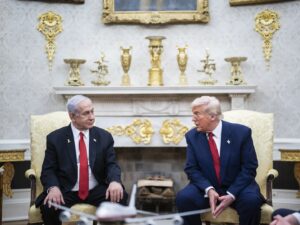
Next week, on December 29th, Israeli Prime Minister Benjamin Netanyahu is scheduled to meet with U.S. President Donald Trump. The lead-up to the meeting has elicited unease among many peace activists due to the belief that Netanyahu is planning to push Trump towards renewed hostilities against Iran. Observers have long accused Netanyahu of seeking to drag the United States into a wide-scale conflict with Iran under the guise of Tehran’s “threatening nuclear capabilities” and thus there is understandable concern that this could be the latest attempt to do so. They have also noted that these recent efforts are driven by Netanyahu’s desire to perpetuate regional tension as a means of shifting attention away from both domestic and international criminal charges against him, in addition to the array of global criticism. All told, analysts are imploring Trump not to take part in potential new Israeli hostilities against Iran, pointing out that U.S. involvement would contradict his “America First” ethos on avoiding harmful foreign entanglements.
Experts have warned that possible U.S. acquiescence with Netanyahu’s lobbying for aggression risks a destructive regional war, undermining Trump’s vows to end and prevent overseas conflicts. Furthermore, as many had outlined this past summer during the 12-day outbreak of hostilities between Israel and Iran, attacks against Iran’s nuclear facilities could in actuality prove counterproductive and instead drive Tehran towards real nuclear proliferation. As such, only a negotiated agreement through means of diplomacy, not belligerence, can provide a viable long-term resolution to questions over Iran’s nuclear program. If Netanyahu does indeed press Trump for new military actions against Iran as expected during their upcoming meeting next week, the American president should push back in favor of pursuing renewed diplomatic engagement with Tehran.
On top of discussions over Iran, Trump and Netanyahu are also expected to focus on a few other main topics including the prospects of moving to phase two of the Gaza ceasefire plan. The upcoming meeting on December 29th comes after the White House recently scolded Netanyahu for blatant violations of the Gaza ceasefire. While rights groups have documented that these have been taking place repeatedly since the initiation of the agreement back in October, the Israeli airstrike that killed a top Hamas commander a couple of weeks ago drew particular ire from the Trump administration. The White House sent what was referred to as a “stern private message” to Netanyahu acknowledging that the strike constituted a direct violation of the ceasefire agreement while also expressing frustration over Israel’s failure to meet the mandate of agreed-upon aid – with much of this still restricted or delayed despite the terms of the deal. Given all of this, it remains to be seen how discussions between Trump and Netanyahu transpire and whether or not any concrete progress can be made towards the transition to phase two of the agreement – especially when so many of Israel’s actions signify an intent to derail this.
In advance of the scheduled December 29th meeting between Trump and Netanyahu, it has become apparent that the two are at odds when it comes to Syria as well. The U.S. has made it clear that it views the new Syrian government as a critical and emerging partner and has therefore grown increasingly frustrated with Israeli military activities in Syria – which they and others view as undermining efforts to stabilize the country. The Trump administration has publicly rebuked Israel for continued airstrikes and ground raids, with Israel refusing to withdraw from areas that it has illegally occupied since the fall of the Assad regime. In light of these circumstances, it is also expected that Trump will use the December 29th meeting to press Netanyahu to halt aggressive and destabilizing posturing in Syria. Israel has continued to conduct daily attacks inside the country in a blatant violation of Syria’s sovereignty and an effort to try to spur instability, with Syrian officials looking to Trump to help curtail this moving forward.
Israeli Government’s $6 Million Deal with Clock Tower X to Produce and Distribute Pro-Israel Content Across Digital Platforms

The Israeli government’s recent $6 million contract with the U.S.-based firm Clock Tower X LLC – led by former Trump campaign manager Brad Parscale – to produce and distribute pro-Israel content across digital platforms has garnered significant criticism for its methods aimed at disingenuously shaping online discourse. The deal seeks to manipulate artificial intelligence (AI) models by “training and influencing” tools such as ChatGPT to produce more pro-Israeli content and propaganda. As such, it represents one of the latest troubling escalations in Israel’s slew of state-sponsored digital propaganda initiatives. The attempt to mold AI algorithms to replicate government-pushed narratives is highly problematic. It is clearly designed to suppress organic denunciation of Israel’s actions and policies – something that has manifested as a legitimate response to its conduct, particularly in recent years since the onset of the Gaza War and as digital platforms have continued to grow in prevalence and usage.
The deceptive motivations behind the effort are evident, especially given the nature of the propaganda campaign. The contract specifies that at least 80% of the content must target Generation Z audiences across platforms like TikTok, Instagram, YouTube, and various podcasts. This has been labeled as a blatant message-twisting attempt to capture a demographic that has become increasingly critical of Israel’s policies and actions. The deal even consists of recruiting influencers and monetarily pushing them to post dozens of times per month – a tactic that has therefore understandably raised concerns about the lack of authenticity and the use of substantial foreign government funds to “buy” digital popularity and clout. Civil liberties advocates highlight how these initiatives undermine free speech by aiming to crowd out dissenting views through the manipulation of content and algorithms. Furthermore, the campaign has been criticized for seeking to cover up undeniable evidence of Israeli human rights violations and war crimes by contradicting findings from reputable international organizations and rights groups. All of this has fueled growing calls for new guardrails on AI and digital platforms in order to prevent the normalization of state-funded propaganda.
The $6 million deal comes amid recent revelations of other Israeli government-pushed efforts to manipulate digital and public narratives. Earlier this month in a previous volume of our newsletter, we outlined how Israel hosted a delegation of around 1,000 American Evangelical ministers and pastors for a state-run propaganda mission while also initiating a massive geofencing campaign designed to target American churchgoers with pro-Israeli propaganda. Similarly to the deal with Clock Tower X LLC, the hosting of church officials and the geofencing seek to promote and spread a biased Israeli state narrative at a time when justifiable criticism of Israel’s conduct and actions has grown globally, including in the United States. This demonstrates how these efforts are obviously a reaction to the organic and widespread uptick in condemnation of Israel’s behavior, with state entities desperately trying to counter this at all costs – resorting to various measures to try to suppress the growing criticism and waning support.
The state-sponsored Israeli attempts to alter digital and public discourse have been prompted by the glaring uptick in criticism, particularly from younger generations. The data consistently shows that Israel is facing a seismic drop-off in support among Gen Z and Millennials, with rapidly growing sympathies in favor of Palestinians and their pursuit of social justice and human rights. The overwhelming majority of younger citizens, both Americans and others around the world, increasingly disapprove of Israel’s actions and policies – with historically high numbers opposing things like military and economic aid to Israel in light of its conduct. Much of the erosion in support is attributed to things like social media and visual documentation of Israeli war crimes and human rights violations, which have become more accessible given the digital age that we live in. Many younger citizens consume news primarily from digital platforms and the unfiltered evidence of Israeli abuses has therefore been constant and impossible to deny. Due to all of this, Israel’s initiatives aimed at countering the growing criticism have become more blatant and prevalent and the $6 million deal with Clock Tower X LLC is merely one of the latest such efforts.
Separatist Gains in Southern Yemen Raise Concern Over the Potential of Heightened Fragmentation and Regional Tensions
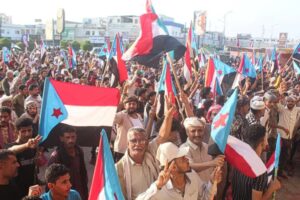
The military gains made as a result of a recent offensive in Yemen launched by the separatist and UAE-backed Southern Transitional Council (STC) have raised concerns regarding the potential of heightened fragmentation of the Yemeni state and regional tensions. The STC has seized a vast amount of Yemen’s territory, including the country’s resource-rich large southeastern governorates of Hadhramaut and Al-Mahra, strategic oil fields, military installations, and areas near the Omani border – amounting to most of southern Yemen. The gains have left the STC in control over approximately 80% of Yemen’s oil reserves and critical infrastructure like the PetroMasila oil fields, and in doing so, deprived the country’s internationally recognized government of many of its primary revenue sources. The military offensive has marginalized the Saudi-backed internationally recognized government, with the STC seeking to form a temporary administrative body to manage the south, further entrenching the push for de facto independence and the country’s fragmented governance structure.
Experts have described the ongoing situation in Yemen as one defined by deep institutional fragmentation and an absence of a unified state system. The country is governed among several competing factions, each exercising varying degrees of control over different regions. The internationally recognized government claims sovereignty over all of Yemen but operates primarily from the interim government seat of Aden with officials often residing in Saudi Arabia due to Houthi control of the Yemeni capital city of Sanaa. The Houthis also control most of northern Yemen and significant portions of the northwestern region and Red Sea coastline – governing many of the areas with the majority of the country’s population. Now, with the most recent developments, the STC – which is nominally part of the executive body of the internationally recognized government but advocates for an independent South Yemen – has consolidated its military control as well by seizing the aforementioned areas in southern and eastern Yemen, leading to increased friction with the internationally recognized government and regional powers like Saudi Arabia.
The STC’s military advances have shed light on the struggle between regional actors Saudi Arabia and the United Arab Emirates over influence in Yemen. The UAE-backed STC’s gains directly challenge Saudi interests and its support of Yemen’s internationally recognized government. As such, Saudi Arabia has rejected the “fait accompli” created in Hadhramaut and amassed tens of thousands of forces on the border – vowing airstrikes if the STC does not withdraw. The STC’s presence in nearby Al-Mahra is also viewed as a direct threat to Oman, which considers the province a vital buffer zone. Thus, both Saudi Arabia and Oman deem the rapid expansion of STC as a threat, exemplified by the recent visit of Saudi Arabia’s foreign minister to Oman earlier this week. The two nations are concerned that the STC’s drive for southern independence will lead to the permanent fragmentation of Yemen, creating unstable areas along their respective borders.
Regional analysts also fear that the Houthis may exploit the current situation to launch new offensives or secure additional resources, potentially reigniting a full-scale civil war. In fact, UN officials have warned that the recent developments in Yemen risk accelerating fragmentation and resulting in a spillover of conflict which could complicate already long-stalled peace negotiations. Furthermore, there is a concern that heightened fragmentation might create security vacuums that extremist groups could exploit as well. Perhaps most alarmingly, there is worry among rights activists that the potential of intensified conflict will exacerbate the already dire humanitarian conditions in Yemen – which is consistently viewed as one of the most severe such crises anywhere in the world. An estimated over 18 million people – nearly half of the country’s total population – are at emergency levels of food insecurity, with at least 5 million believed to be on the brink of famine.

