
The National Interest Foundation Newsletter
Issue 316, January 9, 2026
Welcome to our NIF Newsletter. In this week’s edition, we provide analysis on the U.S. capture of Venezuelan President Nicolas Maduro and international law, examine the unrest in Iran driven by economic hardship and outside forces, and delve into the growing tensions between Saudi Arabia and the United Arab Emirates which have devolved into full-scale confrontation.
Editor: Bassam Tarbush
The U.S. Capture of Venezuelan President Maduro and International Law
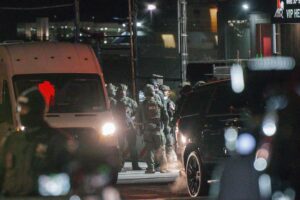
This past weekend on January 3rd, U.S. special forces captured Venezuelan President Nicolas Maduro and his wife Cilia Flores in a military operation dubbed “Operation Absolute Resolve,” transporting the two to the United States to face drug trafficking and narco-terrorism charges. While Maduro is widely viewed as a repressive authoritarian leader, the manner in which he was ousted has garnered concern regarding the legality of the direct U.S. intervention and its potential harmful ramifications. International law experts have questioned the abduction of a sitting head of state, with UN officials stating that the action represents a dangerous precedent which violates its charter on sovereignty and territorial integrity. Additionally, the operation was carried out without authorization from Congress as critics point out that the Trump administration bypassed constitutional war powers. Observers have also contended that the capture was not primarily about the charges used as justification, but rather a move to seize control of Venezuela’s massive oil reserves. On top of all of this, the capture of Maduro and U.S. intervention in Venezuela has elicited condemnation regarding the potential of damaging American entanglement in foreign conflicts through long-criticized efforts at regime change and nation-building which run counter to Trump’s espoused “America First” narrative.
Analysts have raised several critical concerns about the legality or lack thereof of the U.S. operation under international law. The capture of Maduro appears to violate Article 2(4) of the UN Charter, which prohibits the threat or use of force against the territorial integrity or political independence of any sovereign state. The Trump administration has tried to cite Article 51 (self-defense) by claiming that Maduro’s actions constitute a threat to U.S. national security, however legal scholars argue that drug trafficking does not traditionally meet the threshold of an “armed attack” or dire threat. Furthermore, the Trump-approved operation lacked authorization from the UN Security Council and occurred without the consent of the Venezuelan government, making it an unlawful abduction or kidnapping. Under the guidelines of international law, sitting heads of state are typically granted immunity ratione personae – a status which protects them from the criminal jurisdiction of other states. The UN Security Council convened earlier this week for an emergency session over the U.S. operation whereby approximately 20 countries and several major international blocs expressed concern or direct condemnation of the capture of Maduro.
The direct U.S. intervention in Venezuela has led many to raise alarm over the possibility of damaging long-term American entanglement in the country. President Trump’s statements vaguely proclaiming that the United States will “run” Venezuela until a “safe, proper and judicious transition” is achieved have drawn up questions over this and the likelihood of messy and increased U.S. involvement. Adding to the concern, there are fears that the intervention could spur regional instability and create a power vacuum that results in violence and chaos and entraps the U.S. indefinitely. This might very well likely draw in direct U.S. military engagement since the United States has essentially assumed responsibility for Venezuelan internal security and the management of the “day after” circumstances. Rhetoric from the Trump administration towards other countries in the region like Colombia following Maduro’s capture has also intensified unease over potential further regional interventions and U.S. entanglement. Importantly, there are legitimate questions about the true motivations behind Maduro’s capture as well due to the Trump administration’s explicit references to taking control of Venezuela’s vast oil reserves, with many suggesting that the move is at the very least partly driven by a desire to secure access to Venezuela’s energy assets. Various Trump administration officials have bluntly described the operation as a means to recover “stolen oil” and alluded to American oil companies being required to manage and rebuild the country’s infrastructure.
The Trump administration’s long proclaimed “America First” ideology which has emphasized avoiding “forever wars” and prioritizing domestic over foreign interventions is blatantly contradicted by the Maduro operation. The capturing of the Venezuelan leader is viewed as a return to “gunboat diplomacy,” regime change, and nation-building – policies that many advocating for responsible U.S. foreign policy have criticized as destructively draining American resources. Additionally, by acting without congressional notification or a clear international mandate, the Trump administration risks undermining the very international legal frameworks that protect American sovereignty, potentially emboldening other global actors to ignore U.S. interests in the future too. As such, U.S. lawmakers and others have raised both constitutional and strategic concerns regarding the operation to capture Maduro – warning that it could lead to harmful long-term foreign entanglements and ultimately make the United States less safe by provoking responses from U.S. adversaries and diminishing American credibility.
Unrest in Iran Driven by Economic Hardship and Outside Forces
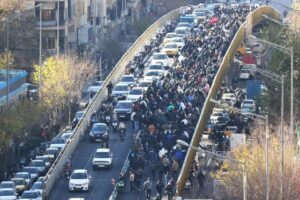
Since late December of 2025, widespread unrest and anti-government protests have emerged across Iran which have been largely driven by a severe economic crisis and exacerbated by outside forces seeking to destabilize the country. The demonstrations represent the largest wave of civil unrest since the 2022 solidarity movement that materialized following the killing of Mahsa Amini, with the current iteration taking place in at least 27 of Iran’s 31 provinces. The unrest began with merchants and shopkeepers in commercial districts launching strikes and closing their businesses to protest major economic grievances. This has seen the rapid collapse of the national currency (as the Iranian rial has plummeted to a new historic low), ballooning inflation rates, and soaring prices for staples such as rice and meat. Economic hardships have been intensified by the resumption of “snapback” sanctions on the Iranian regime which have deepened the country’s already significant isolation from the global financial system. External factors including U.S. President Trump’s threat of American intervention and Israeli covert support for rioters have heightened the crisis and the threat of destabilization.
Observers have tried to shed light on Israel’s attempts to cynically capitalize on the unrest in Iran, with some suspecting that this is designed to create a window for further military actions against Iran in the coming months. The Israeli Mossad has even gone so far as to publicly claim that it was operating within the protests, stating shortly after the unrest started that “We are with you. Not just from afar and verbally. We are with you in the field as well.” This prompted Former U.S. Secretary of State Mike Pompeo to post on X expressing “Happy New Year to every Iranian in the streets. Also to every Mossad agent walking beside them.” Israel’s strategy seeks to foment instability within Iran and exploit existing domestic grievances to amplify civil unrest and threats to the regime in Tehran. In addition to this, U.S. President Trump’s warning regarding potential American military intervention against the regime must be taken seriously when coupled with the recent abduction of Venezuelan President Nicolas Maduro. In fact, the U.S. State Department’s Farsi-language social media account even doubled down on this, posting an image of Trump overseeing the Maduro raid with a threatening caption. Ultimately, many contend that the threats against Iran hold more weight and cannot be casually dismissed in light of what happened to Maduro.
While outside forces have certainly sought to exacerbate the crisis, the dire levels of economic hardship that have sparked the unrest are serious concerns that affect a growing number of ordinary citizens in Iran. As one of the most sanctioned countries in the world, these global restrictions have left Iran struggling to access international financial markets and increasingly reliant on imports – which has fueled skyrocketing inflation and deteriorating economic conditions. In just the past six months alone, the Iranian rial has seen a higher than 50% drop in value. This has ballooned inflation and led to food prices soaring by an average of nearly 75% compared to the previous year. On top of the sharp depreciation of the national currency, there have also been criticisms of the government only offering wage increases that amount to a mere two-fifths of the surging rate of inflation. Furthermore, systemic failures in the energy sector have resulted in nationwide blackouts and gas and water shortages. All of this has left Iran facing an exceptionally severe economic crisis.
What transpires next in Iran of course remains to be seen, however many believe that the country is in the midst of a highly volatile period marked by a concerning convergence of domestic unrest, massive economic collapse, external pressure, and the threat of potential new military intervention from Israel and the United States. The economic crisis itself could very well worsen, as prices for essential goods are expected to jump even further following the government’s decision to end subsidized exchange rates for imports. Public dissatisfaction is also likely to persist given that many deem the planned government concessions to be insufficient. These combined with outside pressures and threats leave the regime in a highly vulnerable state.
Growing Tensions Between Saudi Arabia and the United Arab Emirates Devolve into Full-Scale Confrontation
Heightened tensions between Saudi Arabia and the United Arab Emirates have increasingly spilled over online in recent weeks and devolved into full-scale confrontation. This has seen a notable transition from previously mostly private diplomatic friction to more open public confrontations which have been characterized by targeted online campaigns and contentious social media discourse regarding competing narratives and areas of discord. Analysts have outlined how the hostile exchanges in the digital sphere mark a dramatic shift from years of carefully crafted rhetoric portraying harmonious ties between the two – with Saudi and Emirati journalists, commentators, and others now openly questioning each other’s motives and actions. Saudi voices have been growingly candid and critical about the UAE’s fueling of conflict and instability throughout the region. This is apparent given Abu Dhabi’s support of abusive paramilitary forces in Sudan and secessionists in Yemen and Somalia – among other destabilizing entities. Observers note that while Saudi Arabia and the UAE have been diverging behind the scenes for years, the discord and direct confrontation have now entered a much more public stage with this expected to continue moving forward.
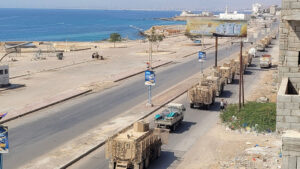
The overt spillover of tensions became evident for all to see recently in late December when Saudi Arabia conducted airstrikes on a UAE-linked weapons shipment at Yemen’s Mukalla port. Riyadh has publicly condemned the UAE and accused Abu Dhabi of seeking to undermine its national security by backing the Southern Transitional Council (STC) separatist group in Yemen. Saudi Arabia views the fragmentation of Yemen as a direct threat to its southern border. In addition to undeniable friction surrounding developments in Yemen, Saudi Arabia has also grown increasingly critical of the UAE’s role in perpetuating conflict and instability elsewhere in places like Sudan and Somalia. This has seen Saudi Arabia lobby the United States to impose secondary sanctions on the UAE for its arming of the abusive Rapid Support Forces (RSF) in Sudan, who have engaged in egregious war crimes and human rights violations. Tensions have even flared recently over the UAE’s ties with secessionists in Somaliland, which Saudi Arabia has also denounced as a threat to regional stability. Overall, Saudi voices have begun publicly denouncing the UAE for what many impartial observers have been seeking to draw attention to for years – Abu Dhabi’s destructive role in sowing instability by supporting disruptive and abusive forces across the region.
The aforementioned Saudi strikes on the UAE weapons shipment were significant for marking the first direct confrontation between the two countries and prompted the UAE to express that they would withdraw any remaining Emirati troops from Yemen. Experts have highlighted how the expanding public discord between the countries boils down to their two fundamentally differing brands of foreign policy. While Saudi Arabia is more focused on bolstering regional stability, the UAE on the other hand is seeking to build what analysts have described as an “axis of secessionists” whereby the Emiratis support a variety of armed non-state entities in places such as Yemen, Sudan, Somalia, and Libya as a means of trying to gain regional influence. Thus, unsurprisingly, this has resulted in Saudi Arabia and the UAE on opposite sides when it comes to an array of regional issues – with this inevitably boiling over into more direct public confrontation. As experts have sought to point out, the competing interests between the two countries are getting more difficult to manage diplomatically, with suggestions being put forth that this is resulting in a kind of “Cold War” taking shape which has manifested in increasing contention online and in public.
The Saudi-UAE rift has deepened further amid some of the latest developments surrounding Yemen. Saudi-backed government forces in Yemen recently launched a major counter-offensive and retook substantial swathes of land from the UAE-backed separatist group – the Southern Transitional Council (STC). These gains effectively reversed those made as a result of the STC’s December offensive and consolidated the internationally recognized government’s control over non-Houthi territory in Yemen. Amid all of this, Saudi Arabia has accused the UAE of smuggling the STC leader out of the country in the dead of night after he skipped planned peace talks in Riyadh, fleeing to Abu Dhabi via Somaliland. To many analysts, this recent occurrence demonstrates the extent of strained relations between Saudi Arabia and the UAE, while indicating that there may be more to come and that ties are expected to remain fraught with friction. There have even been speculations that Saudi Arabia could seek to initiate regime change in the UAE. Irrespective of what may transpire moving forward, the latest course of events in Yemen represent a noteworthy setback to the UAE’s regional strategy of fueling instability, fragmentation, and discord. Ultimately, the growing rift between Saudi Arabia and the UAE is likely to have significant implications for the region.

