

The National Interest Foundation Newsletter
Issue 308, October 31, 2025
Welcome to our NIF Newsletter. In this week’s edition, we look into President Trump’s attendance at the Association of Southeast Asian Nations (ASEAN) summit in Malaysia, examine how Israel has killed over 200 civilians including entire families since the Gaza ceasefire, and provide analysis on the money and bigotry at work in the New York City mayoral election.
Editor: Bassam Tarbush
President Trump Attends Association of Southeast Asian Nations (ASEAN) Summit in Malaysia
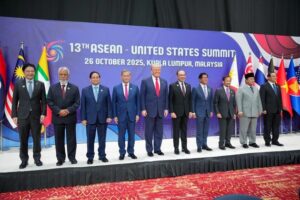
An array of world leaders assembled in Malaysia this week for a three-day summit of the Association of Southeast Asian Nations (ASEAN), including U.S. President Donald Trump. The gathering sought to address a variety of key issues such as economic cooperation, fair trade, sustainable development, access to rare earth minerals, the impact of American tariffs, ongoing disputes in the South China Sea, and the balancing of major power rivalries amid growing U.S.-China competition – among others. Analysts highlighted how the summit provided a critical platform for dialogue and diplomacy, particularly in the midst of intensifying U.S.-China tensions and rising protectionism. For many, the presence of high-profile leaders like Trump and Chinese Premier Li Qiang underscored the ASEAN region’s emerging importance. In fact, their attendance was labeled a notable diplomatic victory for Malaysian officials – who themselves have described this as a sign of ASEAN’s relevance in foreign affairs.
His attendance at the ASEAN summit marked President Trump’s first trip to the region since returning to the White House back in January. Some of the notable developments included Trump’s announcement of several trade agreements aimed at enhancing cooperation with Southeast Asian nations. Experts pointed to the United States’ signing of rare earth minerals deals with the four countries of Japan, Thailand, Cambodia, and Malaysia as a clear strategic move intended to reduce dependence on China in this vital industry – one which plays a key role in modern technology, electronics, and military equipment. By initiating these agreements, the United States seeks to diversify supply chains and diminish reliance on China by securing the aforementioned four nations’ cooperation regarding the processing, mining, and exporting of these minerals. Observers have noted that China has long maintained a stranglehold on this industry – controlling a significant majority of the world’s rare earth mining and processing capacity, giving it a high degree of leverage over global supply. Thus, the recent agreements between the United States and others in the Southeast Asia region are designed to try and break China’s dominance, especially at a time when countries around the world are actively working to build up their own infrastructure in the industry.
Another glaring takeaway from Trump’s participation in the ASEAN summit was his desire to oversee the formal signing of a ceasefire agreement between Cambodia and Thailand – and the motivations behind this. The American president has made it clear that he has set his sights on receiving a future Nobel Peace Prize, and as such, his involvement in the signing ceremony did not come as a surprise to those who have been closely following. Cambodia’s Prime Minister Hun Manet did in fact formally nominate Trump for the Nobel Peace Prize – with this being publicly announced during the ceremony. The move itself was not unexpected as well, as Cambodia’s deputy prime minister had unveiled the plan to do so back in August. Presiding over the signing ceremony provided Trump with a public platform to try and bolster his image as a global peacemaker, even as Thai officials are reluctant to call the ceasefire agreement a “peace deal.” This is understandable, and due to the fact that the agreement only sets initial steps towards de-escalating the recent border conflict but leaves core issues unresolved.
Both the United States and China’s involvement in the ASEAN summit put the delicate balancing act among the bloc’s member countries on full display. Regional experts outlined how the ASEAN bloc’s ability to try and maintain neutrality amid competing U.S.-Chinese interests was clear for all to see. Ultimately, some analysts contended that the summit was successful in allowing these countries to get “the best of both worlds” – drawing in Trump and the U.S. in order to strengthen the regional bloc’s protection against China while at the same time still continuing to do business with Beijing. It also served as a strong signal that the region remains a key and important player in the realm of global diplomacy.
Since the Gaza Ceasefire Israel Has Killed Over 200 Civilians Including Entire Families
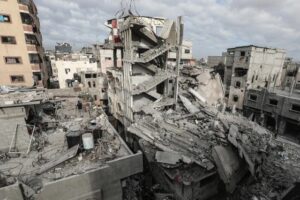
In the weeks since the Gaza ceasefire went into effect on October 10th, Israel has continuously violated the agreement – carrying out attacks which have killed over 200 civilians including entire families, keeping the Rafah crossing closed, and maintaining restrictions on humanitarian aid. Israel has fabricated claims to try and justify its attacks and repeated violations of the ceasefire. Earlier this week on Tuesday and Wednesday alone, Israeli strikes killed more than 100 people, which included dozens of children. Contrary to the terms of the agreement, Israel has not only continued its aerial and artillery bombardment, but it has also not allowed the agreed-upon 600 trucks of humanitarian aid to enter Gaza daily. Instead, it has been documented that only about 15% of the humanitarian aid called for in the agreement has actually been permitted to enter Gaza. In yet another violation of the deal, Israel stated that it would keep the critical Rafah crossing with Egypt closed, despite the fact that it serves as an important humanitarian lifeline for the Gaza Strip and was therefore set to be reopened three days after the ceasefire was implemented under the stipulations of the agreement.
For those that have been closely monitoring what has transpired over the preceding weeks, it is clear that Israel’s actions follow a familiar and often-used pattern of manufacturing a pretext for resuming attacks and spinning the narrative to try and place blame on others for continued hostilities. This is precisely why so many conveyed serious doubts regarding Israel’s willingness – or lack thereof – to comply with the terms of the ceasefire agreement. As has unfolded, fair-minded observers warned that Israel would likely seek to establish a pretense for undermining the ceasefire and continuing to carry out attacks. Analysts have outlined that Israel is deliberately attempting to obstruct a ceasefire deal that it was unwillingly pressured into by the United States. As such, the manner in which U.S. officials respond to this is key. President Trump and others buying into the Israeli narrative for the attacks is regrettable given the multitude of ways in which Israel has violated the ceasefire and its evident underlying motivations and efforts to do so. Through their defense of and response to the Israeli strikes, U.S. officials are giving Israel the cover to commit ceasefire violations at will.
Israel’s strikes which killed over 100 people on Tuesday and Wednesday targeted the courtyard of the Al-Shifa Hospital, residential areas, and tents for displaced civilians. One of the pretexts that Israel has used to try and justify its attacks is the claim that Hamas is intentionally delaying the return of the remaining deceased Israeli hostages. However, even humanitarian groups and U.S. officials have acknowledged that the massive destruction caused by Israel’s bombardment of Gaza has made it extremely difficult to locate and retrieve bodies that are buried under tons of rubble. Additionally, Israel has further obstructed this recovery process by blocking the entry of the heavy machinery and humanitarian search teams needed to carry this out in the first place. Meanwhile, Israel has repeatedly carried out attacks, hindered the amount of humanitarian aid entering Gaza, and continued to block the Rafah border crossing – all three of which are blatant violations of the ceasefire agreement. It has also continued to demolish large swaths of city infrastructure within the more than 50% of the Gaza Strip that remains under its military control.
Like previous ceasefire agreements in Gaza and ones elsewhere involving Israel (such as Lebanon), analysts have pointed out the one-sided aspect of it which has allowed Israel to violate the deal on a daily basis with a lack of accountability. As human rights advocates and legal experts have drawn attention to, Israel has a history of violating ceasefire agreements without significant enough international scrutiny or consequences being enacted against this type of behavior. It is lamentable that Israel has been allowed to systematically violate multiple aspects of the ceasefire agreement. Those with leverage over Israel’s conduct – namely the United States – should instead be ensuring its full compliance with the deal in order to maximize any chance of sustainable and lasting peace.
New York City Mayoral Election: Money and Bigotry at Work

As the 2025 New York City mayoral election this coming Tuesday, November 4th approaches, many observers have expressed alarm at the nature of the attacks that have been directed at Democratic nominee and frontrunner Zohran Mamdani. The election sees New York State Assemblymember Mamdani pitted against Republican candidate Curtis Sliwa and disgraced Former New York Governor Andrew Cuomo – who lost the Democratic primary to Mamdani back in June and has since decided to run a third-party bid as an independent candidate. Mamdani’s upset victory in the Democratic primary over the far more established and well-funded Cuomo was viewed as a breath of fresh air in American politics. His grassroots mobilization efforts and ability to galvanize young and new voters in order to form a diverse base of support overpowered Cuomo’s campaign. Alongside this, however, it has opened the door for a wave of disturbing bigoted rhetoric against Mamdani, in addition to an increase in “big money” backing behind the Cuomo campaign.
Since Mamdani’s Democratic primary win, the makeup of the attacks against him has shed light on a troubling common theme of bigotry and Islamophobia. Some of the familiar racist tropes have included an attempt to associate him with terrorism and extremism, depictions as being foreign or “un-American,” and painting him as a “threat” to American society. Most concerningly, these have not come from fringe groups or entities but instead have been deployed by major political figures such as his electoral opponents. Cuomo has not only failed to condemn the bigoted attacks but has even joined in on them. During a recent radio interview, the former governor laughed after the host said that Mamdani “would be cheering” if another 9/11 attack occurred, responding in agreement to the remark by saying “That’s another problem.” Additionally, a super PAC tied to Cuomo’s campaign ran an ad that featured Mamdani’s face superimposed with the phrase “Jihad on NYC.” Slanders like this have also come from the Republican candidate in the mayoral race, Sliwa, who has baselessly commented that Mamdani “supports global jihad.” Furthermore, Mamdani’s criticism of Israeli government actions and policies has left him subjected to the too often deployed wrongful conflation of this with antisemitism. As social justice advocates have long pointed out, this is highly problematic as it shields Israel from valid criticism by trying to tie this to the immorality of antisemitism.
On top of the evident bigotry, there has also been an uptick in “big money” spending in support of Mamdani’s opponent Cuomo as harmful entities look to reshape the mayoral election. Following his re-insertion into the race via a bid as an independent candidate, Cuomo has seen a significant boost in his campaign finances through donations from a mix of wealthy individuals – once again demonstrating the negative influence of “big money” on American politics. Cuomo received a large number of contributions the day after incumbent New York City Mayor Eric Adams dropped out of the race for a second term. Much of this financial influx has gone towards super PACs, with millions being spent on attack ads against Mamdani. Despite all of this, Mamdani has maintained overall leads in both polling and money, thanks in large part to continued broad and enthusiastic support of his campaign among everyday New Yorkers – which has resulted in a massive lead in the amount of public funds received. Research groups have documented how small donors are driving Mamdani’s overall fundraising advantage and that his campaign has garnered significantly more public funding than his opponents because the majority of contributions qualify for matching funds. The widespread scale of his supporter base is highlighted by the fact that a whopping more than two-thirds of campaign contributors donated less than $100 – showing the degree to which the Mamdani campaign is resonating among ordinary citizens. As Mamdani campaign spokespeople have expressed, while “billionaires continue to throw out their last-ditched efforts to prop up Andrew Cuomo, we have genuine enthusiasm and 80,000 volunteers on our side.”
The final outcome of Tuesday’s election remains to be seen, but what is already clear is that multiple elements surrounding the 2025 New York City mayoral race have been alarming to see. Chief among these is the injection of bigotry and destructive “big money” spending in an attempt to influence the electoral result and derail what has been an organic political movement driven by a diverse coalition of supporters. At the same time, it has been encouraging to witness the resilience of the Mamdani campaign in the face of all of this. Regardless of outcome, many have been impressed at the graceful handling of the bigoted attacks which have demonstrated the importance of continuing to push back against these and strive towards a more tolerant society.

