
The National Interest Foundation Newsletter
Issue 317, January 16, 2026
Welcome to our NIF Newsletter. In this week’s edition, we explore the Iranian government’s crackdown on protests amid threats of foreign intervention, look into the unprovoked Syrian Democratic Forces (SDF) shelling of Aleppo which prompted days of clashes with the Syrian government and a tenuous ceasefire, and examine a recent AP-NORC poll which found that a majority believe President Trump has gone too far in using the U.S. military to intervene abroad.
Editor: Bassam Tarbush
Iranian Government Cracks Down on Protests Amid Threats of Foreign Intervention
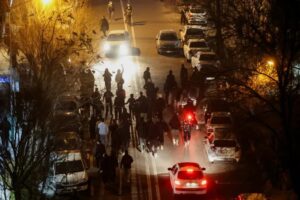
Security forces in Iran have carried out a systematic crackdown on nationwide protests that have emerged since late December. The suppression tactics have come amid and despite repeated threats of foreign intervention from U.S. President Donald Trump. Even in the face of this, the Iranian regime has chosen to adopt an overtly defiant and confrontational stance regarding its crackdown. It has used state media and official declarations to broadcast its intent to use lethal force and rapid executions to maintain control, with officials publicly signaling that detained protesters will face expedited trials and punishment. At the same time, authorities have sought to enforce a near-total information blackout to obscure the full scale of the lethal crackdown. Nevertheless, human rights and monitoring groups suspect that the death toll has already exceeded any previous round of unrest in decades. Many have contended that the longer the unrest continues, the higher the likelihood of outside intervention and as such, the regime has been keen to clamp down aggressively and swiftly.
Since late last week, authorities in Iran have instituted a near-total nationwide communications blackout as a means of suppressing and disrupting protests. The blackout has been noted for its unprecedented severity, reaching connectivity levels as low as 1% of normal traffic and extending to landline telephone services. In an effort to counter this and bypass the blackout, the Trump administration has coordinated with Elon Musk to provide anti-government protesters with upwards of 80,000 Starlink terminals – with Musk making the internet service free to users with receivers in Iran during the ongoing demonstrations. Using Russian and Chinese military-grade jamming technology, Iranian authorities have been able to block up to 90% of the Starlink signals and traffic, while government police have also worked to identify and arrest many users. They have reportedly used drones to patrol rooftops to locate and confiscate Starlink antennas, with security forces even conducting door-to-door raids to do so as well. With all of this, it is clear that the regime has employed these types of tactics to not only disrupt the protests and suppress details of its crackdown, but also to exert a high degree of control over the narrative surrounding the unrest.
Similarly to the use of the communications blackout to try to quell the unrest and maintain control, the regime has aimed to exploit threats of foreign intervention in order to consolidate its harsh response to the protests. Tehran has used the rhetoric coming from U.S. President Trump as an attempt to justify the use of maximum force and create its own counter-narrative to the unrest. The regime has leveraged threats of foreign intervention to frame its domestic crackdown as a necessary defense of national sovereignty. This is particularly deployed internally within the regime itself to convince security forces that they are fighting an extension of an outside meddling entity, rather than their own citizens. For most fair and impartial observers, the truth lies somewhere in the middle – as there are certainly external agitators that have sought to capitalize on the unrest, but at the same time, the protests have also been fueled by genuine dissatisfaction from everyday citizens. This is why many peace activists feel that the threats of foreign intervention are harmful and counterproductive, as they provide the regime in Tehran with an excuse to present justifications for its suppression.
The precarious circumstances prompted the U.S. to announce plans to withdraw some personnel from its military bases in the Middle East. This came after senior Iranian officials warned several regional countries that they would strike American bases in the case of an attack by the United States. Amid these rising tensions, some of the aforementioned regional countries such as Saudi Arabia, Qatar, and Oman have engaged in diplomatic efforts to prevent what would be a catastrophic broader regional war – urging de-escalation from all parties and seeking to dissuade the Trump administration against military action given the destabilizing impact that it would have on the entire region. Over the past two days, reports have indicated that the security warning level at U.S. military bases in Qatar and elsewhere in the region were lowered after President Trump suggested that the situation in Iran might be easing, with some aircraft and staff beginning to return. Additionally, after a temporary closure on January 14th due to fears of potential imminent U.S. strikes, Iran reopened its airspace to commercial traffic yesterday. Still, in the midst of all of this, both the United States and Iran remain on high alert due to the fluid nature of the situation, though these recent signs of a possible easing of tensions have emerged and been cautiously welcomed.
Unprovoked SDF Shelling of Aleppo Prompts Days of Clashes with the Syrian Government and a Tenuous Ceasefire
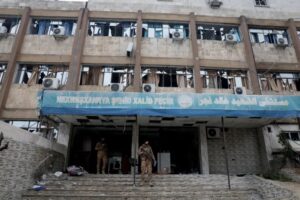
Following days of clashes last week, the Syrian government and Kurdish-led Syrian Democratic Forces (SDF) reached a deal brokered by U.S. officials that is aimed at putting an end to the recent troubling outbreak of fighting in Aleppo. The agreement stipulated the withdrawal of SDF fighters from Syria’s second-largest city, with government forces coordinating buses and a security escort in an effort to transport them to SDF-controlled territories in northeastern Syria east of the Euphrates River. Analysts have highlighted this as a significant development as it marks the withdrawal of the group’s forces from pockets and neighborhoods in Aleppo such as Sheikh Maqsood and Ashrafiyah that they have controlled since 2011. Thus, as a result, many view it as a strategic victory for the new Syrian government in its attempts to centralize state authority and exert control, while also paving the way for the return of thousands of displaced civilians. However, even as a degree of stability has returned to Aleppo, the prospects of the Syrian government being able to successfully centralize authority in the long-term remain in flux and fraught with obstacles given that the root cause of the clashes – the stalling of the process to integrate the SDF into the national army – remains unresolved.
The latest fighting was triggered by a failure to implement the March 2025 agreement which sought to integrate the SDF into the national Syrian army. The end of 2025 deadline for this passed without progress, leading the Syrian government to view the isolated Kurdish-controlled enclaves in Aleppo as a challenge to its central authority. During talks between the SDF and the Syrian government in Damascus, the latter proposed incorporating SDF forces into the Syrian military, but the SDF has continued to insist on self-rule. Both Syria and nearby Turkey have refused this. The early January violence broke out when SDF troops began shelling Aleppo in an unprovoked manner, and in doing so, killing civilians. Many have suggested that the recent SDF attacks have been supported by Israel – an external entity which has already received a wide array of criticism over the past year for its repeated attempts to destabilize the new Syrian government. There have even been recent rumors that other destabilizing actors in the region like the United Arab Emirates (UAE) have also lent their support to the SDF, with reports of both the UAE and Israel arming the SDF and other Kurdish groups in Syria. For years, the SDF has been a major counterterrorism partner of the United States in fighting against ISIS but despite this long-running support, the U.S. has developed close ties with the new government in Damascus as well and pushed the SDF to abide by the terms of the March 2025 deal.
In addition to the March 2025 agreement, Syria has signed a military cooperation deal with Turkey which seeks to counter destabilizing militant groups and help strengthen Damascus’ centralized control. Similarly to the new government in Damascus, Turkey has also grown impatient with the SDF’s failure to abide by set-out conditions and integrate into the Syrian state. Thus, the Turkey-Syria cooperation has involved discussions for Turkey to expand its operations against the SDF and other militant groups within a substantial buffer zone in northern Syria. Likewise, the U.S. has emphasized the need for these forces to be pushed east of the Euphrates River. The SDF occupies roughly 25% of Syria, but the issue lies in the fact that it holds areas with significant energy resources such as oil and gas fields as well as critical agricultural lands and water infrastructure. All of this is why the prospect of Syria’s future economic recovery and stabilization hinges on the new government in Damascus being able to regain control over these vital resources.
While a tenuous calm was brought about by the SDF withdrawal, the group is believed to be regrouping and amassing troops north and east of Aleppo – which prompted the Syrian army to declare areas in the eastern Aleppo countryside as closed military zones. As such, experts fear that the risk of further clashes persists, particularly in strategically sensitive and contested areas. The Syrian army has criticized the SDF for destroying multiple bridges connecting government-held territories to SDF-controlled ones in an attempt to hinder additional government advances. Furthermore, the Syrian government continues to call on militant groups to withdraw to the east of the Euphrates River, accusing them of launching drones against civilians in Aleppo. Tensions have therefore shifted from the city of Aleppo itself to the surrounding countryside, with concern regarding the potential for a renewed outbreak of violence despite ceasefires and efforts to de-escalate.
AP-NORC Poll Finds That a Majority Believe President Trump Has Gone Too Far in Using the U.S. Military to Intervene Abroad
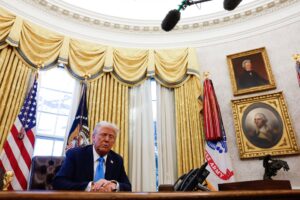
A recent poll conducted by AP-NORC has revealed that a majority of Americans contend that President Trump has gone too far in using the U.S. military to intervene abroad, in addition to other notable findings regarding his foreign policy decisions. The survey sheds light on an American public that has become increasingly wary of U.S. global military entanglements. It also aligns with a growing preference for the prioritization of paramount domestic concerns over foreign policy overextension – with the latter being more frequently criticized in recent years for taking vital resources and attention away from addressing the former. The AP-NORC poll’s findings are particularly relevant in the current political climate given the series of aggressive foreign policy moves undertaken since the beginning of Trump’s second term in office and suggest a considerable degree of public unease towards them.
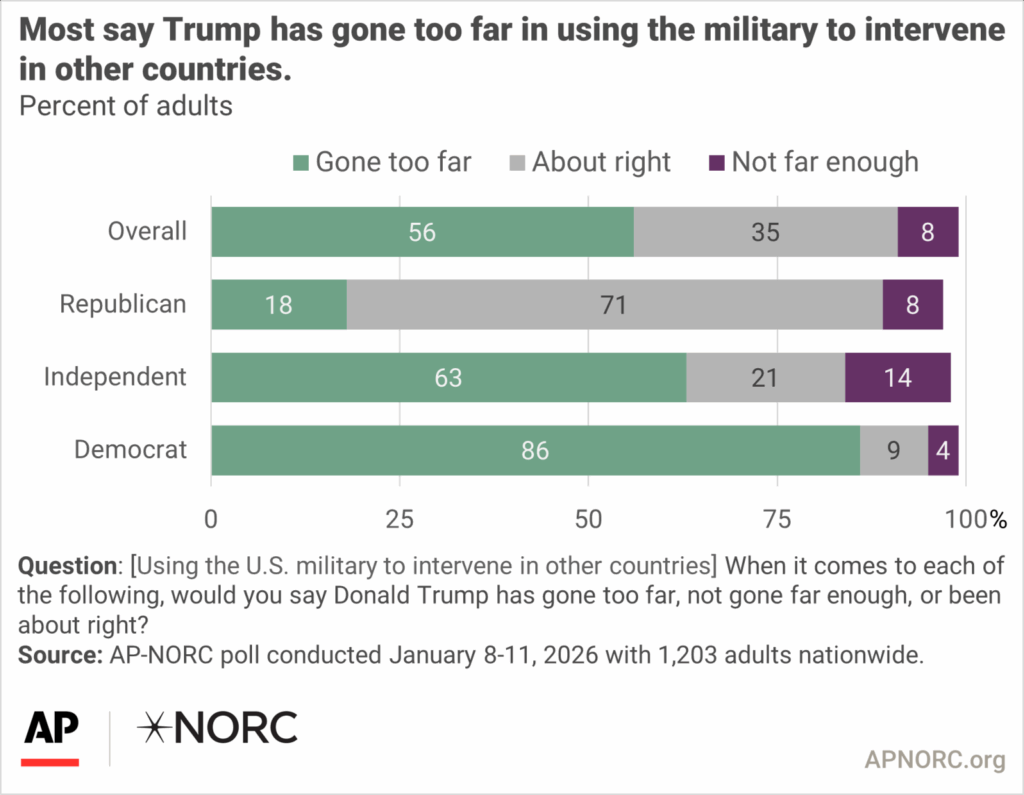
One of the major findings from the poll was the belief shared by a majority of Americans that Trump has gone too far in his use of the U.S. military to intervene in other countries. Overall, 56% of total respondents expressed this viewpoint, including a sizable 86% of Democrats and 63% of Independents. This falls in line with the increasing number of voices that have become critical of Trump’s foreign policy approaches due to the fact that he vehemently campaigned on a non-interventionist platform – one that many see as contradictory with his actual actions and policies. On top of the host of instances of direct U.S. military interventions and strikes, the Trump administration has also threatened military action regarding the status of Greenland, protests in Iran, and other recent occurrences.
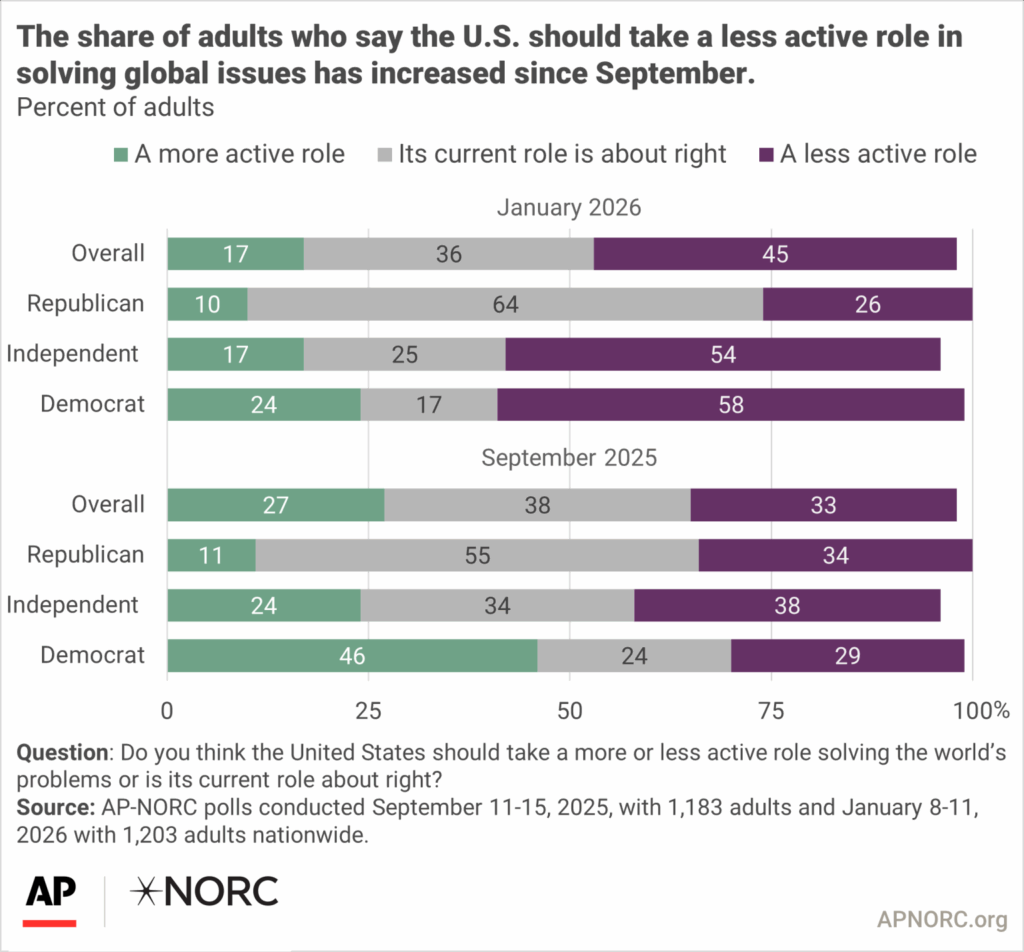
The poll also uncovered a significant uptick in the percentage of Americans who think that the United States should take a less active role in solving global issues. Back in September of last year, 33% of respondents felt this way compared to 27% who conversely felt that the U.S. should take a more active role. Now, merely four months later, the gap between these two figures has widened substantially – with 45% favoring a less active role as opposed to only 17% supporting a more active one. The change can likely be attributed to several key factors such as the backlash against recent military interventions (i.e. U.S. operation to capture Venezuelan President Nicolas Maduro), a desire for increased focus on domestic priorities, and fatigue regarding aggressive and interventionist foreign policy. These findings are consistent with other recent polls which have revealed that much of the American public’s focus has shifted away from international issues and towards urgent domestic concerns like affordability, high living costs, the state of the economy, and healthcare.
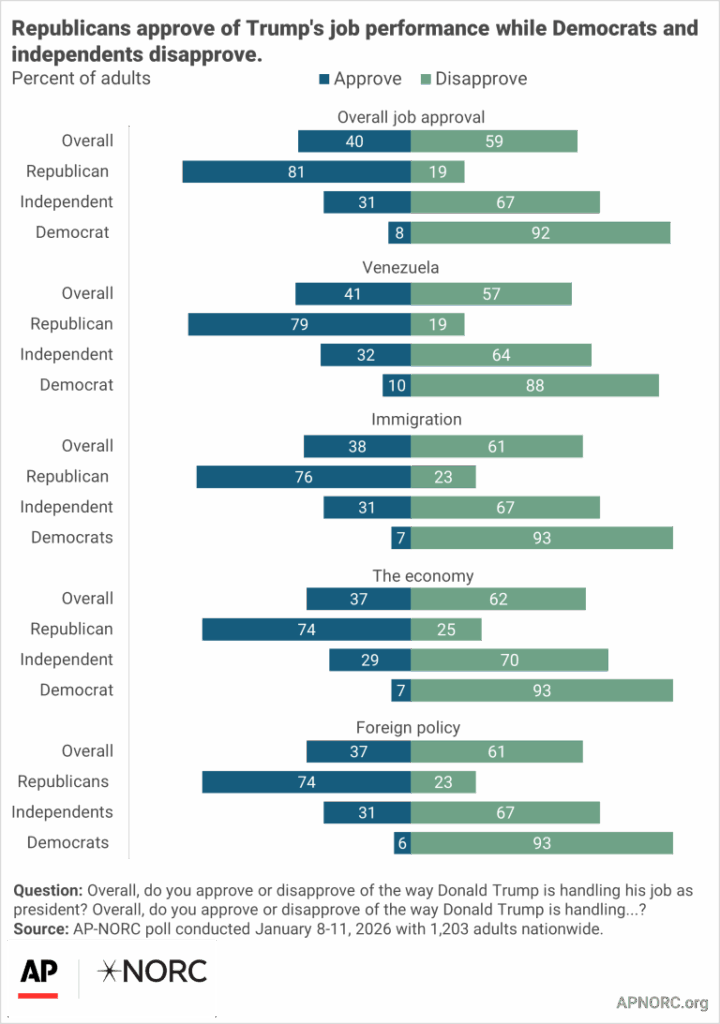
While Trump’s overall approval ratings have stayed relatively the same compared to recent months (about 4 in 10 approving vs. 6 in 10 disapproving), it is noteworthy that his numbers are the lowest (37% each) when it comes to both the economy and foreign policy. Trump of course campaigned largely on his promise to – above all – alleviate economic conditions and it is therefore telling that perception of his handling of this “core” issue is even less favorable than what are already consistently low overall approval ratings during his second term in office thus far. Additionally, with Trump focusing a great deal of his attention on foreign policy-related issues, the poll findings demonstrate that this has in no way translated into most Americans approving of his approaches to these areas. Thus, some have speculated that continued increased negative attention towards Trump’s foreign policy is likely to only become even more of a liability moving forward due to its sharp contrast with the “America First” narrative and platform that he ran on and Americans’ growing concerns with issues at home.

