

The National Interest Foundation Newsletter
Issue 318, January 23, 2026
Welcome to our NIF Newsletter. In this week’s edition, we delve into the major advances by government forces that have prompted the Syrian Democratic Forces’ (SDF) rapid retreat in northeast Syria, while also examining the analysis which shows that Israel has attacked Gaza nearly every day since the October ceasefire and killed more than 460 civilians.
Editor: Bassam Tarbush
Major Advances by Government Forces Prompt the SDF’s Rapid Retreat in Northeast Syria
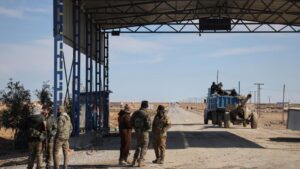
The Syrian government has made key territorial gains in the country’s northeast, significantly consolidating its control over the entire nation and prompting Syrian Democratic Forces’ (SDF) rapid retreat. The recent developments mark a notable geopolitical shift in the post-Assad era, as the new government seeks to unify the country under a central authority following years of fragmentation and conflict. Government forces have seized control of major cities and oil and gas fields from the SDF which are critical for the country’s economic recovery and prospects of stability, as well as strategic infrastructure such as the Euphrates Dam. In the aftermath of these gains, the Syrian government announced a fragile ceasefire agreement aimed at giving the SDF several days to begin integrating soldiers into the Syrian national army in order to continue efforts towards bringing Syria under the direct central authority of the Damascus government. As mediating officials have sought to point out, the latest developments represent a critical juncture whereby the SDF is being offered a pathway to full integration into a unified Syrian state – something that was long denied under the repressive previous Assad regime.
Observers have outlined how the shifting geopolitical landscape in Syria is largely due to the United States’ attempts to bolster the legitimacy and stability of the new Syrian government, and in turn, a recalibration of its longstanding support for the SDF. As highlighted by U.S. Special Envoy for Syria Tom Barrack, “Historically the U.S. military presence in northeastern Syria was justified primarily as a counter-ISIS partnership. The SDF proved the most effective ground partner in defeating ISIS’s territorial caliphate by 2019…At that time, there was no functioning central Syrian state to partner with [but today] the situation has fundamentally changed. Syria now has an acknowledged central government that has joined the Global Coalition to Defeat ISIS (as its 90th member in late 2025), signaling a westward pivot and cooperation with the U.S. on counterterrorism. This shifts the rationale for the U.S.-SDF partnership: the original purpose of the SDF as the primary anti-ISIS force on the ground has largely expired, as Damascus is now both willing and positioned to take over security responsibilities, including control of ISIS detention facilities and camps.” Additionally, Barrack has emphasized that integration into the new Syrian state not only offers Kurdish participation in governance which goes far beyond the semi-autonomy the SDF held amid the fragmentation of conflict in Syria, but a failure to integrate would also open the door for instability and even the potential of ISIS resurgence. Barrack has also expressed displeasure with leadership of the SDF for itself contributing to instability in Syria and seeking to drag destabilizing regional entities like Israel into internal Syrian affairs.
The United States, Turkey, and others have urged the SDF to accept the Syrian government’s offer aimed at integration into the state. Both the U.S. and Turkey have voiced their support for the new government – which seeks a united Syria under the central control and authority of Damascus. After suffering expansive territorial losses to the Syrian government, the SDF was compelled to accept a 14-point deal that outlines a sweeping integration into the Syrian state, as well as the immediate and full handover of provinces, border crossings, prisons, camps, and oil and gas fields to the central government for state protection and resource management – aspects that analysts have long outlined are vitally important for Syria’s economic recovery. As a part of the deal, the Syrian government reaffirmed its commitment to continuing its fight against ISIS and other terrorist networks alongside the United States as a now active member of the International Coalition in order to ensure the security and stability of the region at-large. Damascus also stressed its desire to pave the way for the safe return of displaced residents in northeast Syria to their homes. Notably, SDF personnel are expected to integrate on an individual basis, rather than as cohesive units, as it had been demanding. Thus, the agreement would effectively dismantle the SDF as an autonomous military entity. On January 20th, a new four-day ceasefire was announced to allow for further internal consultations and a practical mechanism for the integration to begin.
As experts have sought to highlight, the framework for integration has received the backing of major mediating parties like the U.S. and Turkey due to its fairness and being viewed as the best chance to guarantee Syria’s stability moving forward. The agreement explicitly recognizes and codifies Kurdish rights through state laws and presidential decrees, including cultural and linguistic recognition. Ultimately, what Damascus is rejecting is the idea of armed self-rule, not Kurdish identity or rights, as the deal would transfer these rights into the state itself instead of leaving them dependent on militias outside of the state apparatus. Furthermore, by dismantling parallel entities of the state and consolidating control under a central authority, the prospect of enduring stability will be significantly bolstered. The framework for integration prioritizes Syrian territorial unity and security as well through the dismantling of autonomous structures which pose a threat to the state sovereignty of not only Syria, but its regional neighbors. International mediators view the individual-based integration of vetted SDF members, as opposed to keeping intact full units, as necessary in order to restore a single centralized national chain of command. This is an essential component for attracting long-term and much-needed reconstruction investment into the country, as it seeks to recover following years of conflict and repression.
Analysis Shows That Israel Has Attacked Gaza Nearly Every Day Since the October Ceasefire and Killed More Than 460 Civilians
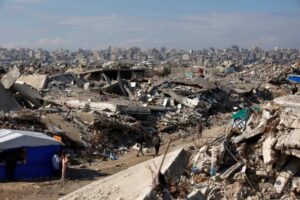
A recent analysis of news reports conducted by Al Jazeera has demonstrated the extent to which Israel has repeatedly violated the October 2025 ceasefire agreement in Gaza. Since this went into effect back on October 10th of last year, Israel has initiated near-daily military attacks in Gaza which have consisted of airstrikes, direct shootings against civilians, ground incursions, and property demolitions. During this time, more than 460 have been killed, with nearly 1,300 more injured. Additionally, humanitarian aid has continued to be heavily restricted. Despite the agreement stipulating that at least 600 aid trucks be allowed to enter the territory daily, only a daily average of between 150-250 have been actually permitted in the first three months – equating to a mere 25% to 41% of the agreed upon amount. Yet again this week, Israeli forces also struck and killed multiple journalists in an attack on their clearly marked press vehicle in central Gaza. Even prior to this latest occurrence, press organizations had already documented how the war in Gaza had become the deadliest conflict ever for journalists – with at least 270 being killed. All told, international monitoring groups have documented close to 1,250 Israeli violations of the ceasefire agreement over the past few months since its implementation.
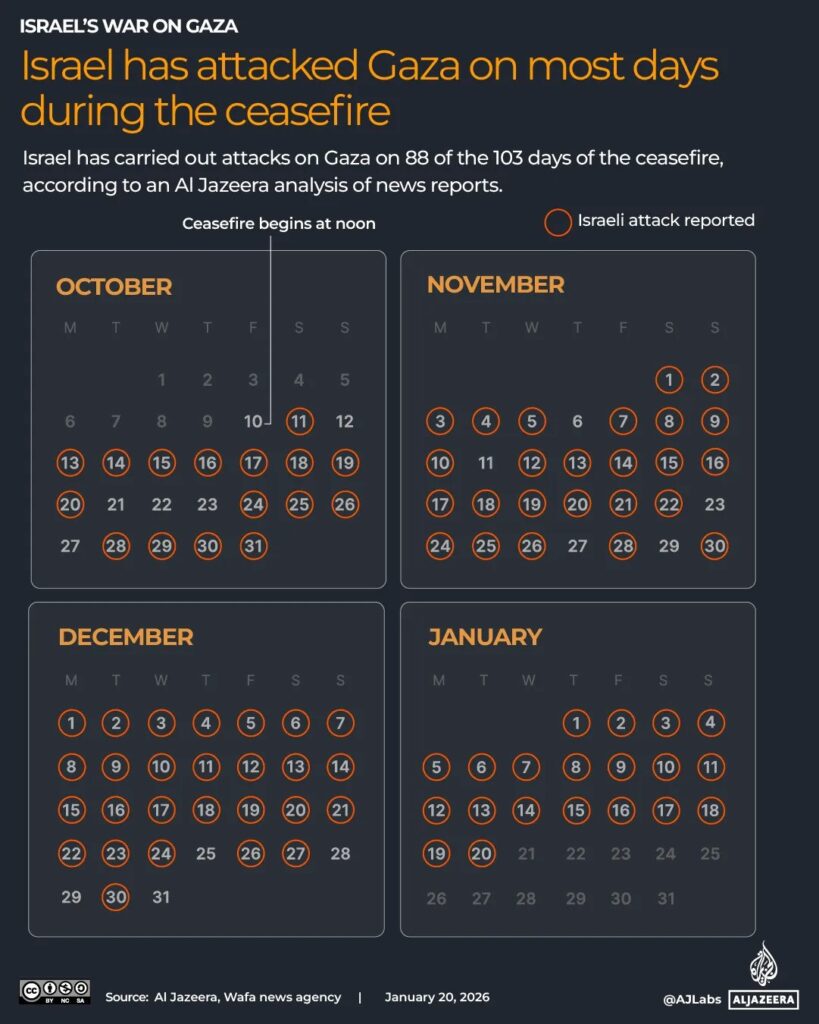
An in-depth look at Israel’s military attacks over the course of the full calendar of days since the beginning of the ceasefire shows just how recurrent the almost daily violations have been. In the 103 days between October 10th, 2025 (the day that the ceasefire went into effect) and earlier this week on January 20th, 2026, Israel was found to have carried out attacks in Gaza on an appalling 88 of these days. Thus, the evidence highlights that only an alarming 15 days during this close to three-and-a-half-month period have been free from violent attacks, killings, injuries, and continued displacement of civilians. Despite the repeated attacks, the United States maintains that the ceasefire is holding – even as belligerent Israeli military activity persists on the ground. As such, the Trump administration has faced significant levels of criticism for its failure to hold Israel accountable for the aforementioned at least 1,250 Israeli violations of the ceasefire since October. Observers have outlined how the administration’s “blind spot” regarding continued Israeli military attacks and clear evidence of noncompliance is undermining the very peace plan that it brokered. Rights groups contend that the refusal to pressure Israel has led to a catastrophic shortfall in aid, with the levels of this failing to even reach 50% of what was stipulated as a part of the ceasefire agreement. Furthermore, the Trump administration has been criticized for going so far as to publicly defend destructive and controversial Israeli actions – such as its targeted assassinations of Hamas officials after the implementation of the Gaza ceasefire agreement. Instead, as has been pointed out, Trump officials should be denouncing these and other violations as blatant breaches of the truce that risk a return to full-scale conflict.
The continued Israeli ceasefire violations and lack of accountability for these by the Trump administration come as the latter also faces substantial criticism for its “Board of Peace” (BoP) initiative in Gaza. Various countries, including many strong traditional U.S. allies, have expressed concern that the board seeks to bypass established international institutions like the United Nations and lacks a neutral monitoring mechanism to address ongoing violations. This has resulted in nations like France, Norway, and Sweden declining to join the initiative, while others have yet to commit or relayed serious reservations. In fact, the calls for an independent global monitoring mechanism as an essential component of phase two of the Gaza plan in light of repeated Israeli ceasefire violations have intensified in recent weeks, with entities calling for a neutral body to oversee the ceasefire and delivery of humanitarian aid in order to prevent further breaches. Without this in place, the ceasefire will remain extremely fragile and prone to the constant potential of complete collapse.
Those concerned with the BoP plans in Gaza and the ongoing circumstances surrounding them have sought to draw attention to the major challenges that they fail to address, which threaten the sustainability of the ceasefire agreement and any prospect of transition to long-term stability. Most troubling, the initiative is seeking to transition to the outlined second phase of the Gaza plan despite a failure to fully and properly implement and enforce phase one – given the clear evidence of repeated Israeli ceasefire violations and continued obstruction of humanitarian aid. On top of this, the BoP lacks neutrality and independence, with the board’s leadership consisting heavily of Trump loyalists and allies including U.S. Secretary of State Marco Rubio, Trump’s son-in-law Jared Kushner, and special envoy Steve Witkoff. There is also widespread apprehension that the board undermines core principles of multilateralism and international law, and in doing so, disregards the fundamental rules of the United Nations Charter by creating a rival diplomatic body. Lastly, and of additional grave unease, is the ignoring of the escalating unlawful Israeli actions in the occupied West Bank – an issue of vital importance for any purported initiative aimed at bringing about lasting peace and stability.

