
The National Interest Foundation Newsletter
Issue 327, March 27, 2026
Welcome to our NIF Newsletter. In this week’s edition, we look into the Trump “decapitate and delegate” foreign policy approach and how it compares with the George W. Bush era doctrine of nation-building, examine a recent Mossawa Center report which sheds light on systematic inequities in Israel uncovered by the Iran war, explore how U.S. public opinion reveals that the majority of Americans disapprove of the Trump administration’s military actions in Iran, and analyze the shifting political landscape in the U.S. amid economic anxiety and other areas of voter dissatisfaction.
Trump’s “Decapitate and Delegate” Foreign Policy Approach and How It Compares with the George W. Bush Era Doctrine of Nation-Building

In recent speeches and remarks, President Trump has boasted about his administration’s actions in Venezuela, signaled that Iran is the current focus, and suggested that Cuba could be next in line for American intervention. Discussions surrounding the Trump administration’s foreign policy strategy have often focused on how it differs from past approaches. Yet a closer look suggests that, despite changes in language and style, there are notable continuities between it and earlier iterations of U.S. foreign policy intervention – particularly as it relates to the George W. Bush era doctrine of nation-building. Under President Trump, what has been coined the “decapitate and delegate” approach has taken shape as a strategy that seeks to target and remove adversarial leadership while claiming to then avoid long term U.S. involvement in the rebuilding that follows. Rather than committing to nation-building, Trump has favored using military or economic pressure to weaken central governments and then leaving the aftermath to regional allies, local actors, or shifting internal dynamics. This reflects a purported view that the United States should not be responsible for managing other countries after intervention, even if the immediate result is instability or uncertainty which raises serious questions about the grave risk that it poses of long-term and undesirable American entanglement.
At the center of both Trump and Bush’s approaches, we see a reliance on American military power to reshape political systems abroad. In the early 2000s, the United States pursued the removal of hostile regimes in Iraq and Afghanistan, operating on the belief that eliminating leadership structures could open the door to a more favorable political order. Today, the current strategy similarly prioritizes targeting leadership and weakening state authority in adversarial countries. While the follow-through may differ, the initial premise remains consistent, with U.S. power being used to alter the internal dynamics of another state. This focus on leadership removal reflects a shared assumption that political systems in adversarial countries are highly centralized and that destabilizing the top layer can produce broader change. Whether framed as regime change or strategic disruption, both approaches treat the structure of leadership as a key pressure point. In practice, this has meant prioritizing strikes on command centers, senior officials, and core institutions tied to state power and control.
Another similarity lies in the expectation that removing or weakening leadership will trigger internal transformation. During the Bush years, this belief was tied to the idea that new political systems could emerge once existing regimes were dismantled. In the current approach, there is still an underlying assumption that internal actors or regional forces will respond to a weakened central authority. The expectation of change following disruption remains a core feature of these types of approaches. In Iraq, the rapid collapse of Saddam Hussein’s government was followed by a prolonged period of instability that was not fully anticipated or adequately planned for. Circumstances like these also create a void and power vacuum that can be filled by other undesirable forces. Today, similar risks are present in discussions about Iran and other potential conflict zones. While the current strategy places less emphasis on managing the aftermath, it still proceeds with the understanding that outcomes may be unpredictable.
There is also a common thread in how these strategies interact with regional dynamics. U.S. interventions rarely occur in isolation. In both periods, actions taken against one country have broader implications for neighboring states and regional balance. Efforts to weaken a central government can shift power toward non-state actors, rival governments, or external entities seeking to expand their influence. This dynamic has been a consistent feature of American involvement in the Middle East.
Relationships with alliances are similar as well. During the Bush era, partnerships with regional allies were central to both military operations and broader strategic goals. In the current context, coordination with allies continues to shape decision making, particularly in regions where security concerns overlap. While the structure of these relationships may vary, the influence of allied interests remains part of the policy environment.
In both cases, military action has been framed as necessary to protect national security and prevent future risks, while also being criticized as reckless and liable to result in uncontrollable and wider scale conflict. Presidents have sought to point to potential threats, whether immediate or longer term, as attempted justifications for intervention. However, framing like this has garnered concern that these types of aggressive military actions may actually do more harm than good. Taken together, these similarities between the Trump and Bush interventionist foreign policy approaches suggest that the current policy is less of a departure than may initially appear. While the language surrounding intervention has shifted, the underlying motivations behind it demonstrate continuity. The use of force to reshape political environments, the focus on leadership as a key target, and the expectation that disruption can lead to change all connect present decisions to earlier strategies. Even as administrations change, certain core assumptions about power, strategy, and influence continue to shape aspects of interventionist U.S. foreign policy just as they did over two decades ago.
Mossawa Center Report Sheds Light on Systematic Inequities in Israel Uncovered by the Iran War

A recent report by The Mossawa Center has sought to draw attention to systematic inequities affecting the Arab Palestinian community in Israel during the past few weeks since the outbreak of the Iran war. The civil rights organization has documented a host of concerning developments including arbitrary arrests, a consistent failure to protect Arab civilians, restrictions on freedom of the press, and a reduction in resources allocated to the Arab community, among others. While systematic discrimination of Palestinians in Israel is far from a new phenomenon, within recent weeks, the Iran war has made it even harder to ignore. What is becoming increasingly clear is that inequality is not only social, but embedded in legal systems, public policy, and even protections that are meant to apply to all citizens. Safety should be a universal right, but that is not the case for non-Jewish citizens in Israel.
One notable example of this outlined in the report relates to how Arab civilians in Israel do not receive the same amount of access to bomb shelters – something that is particularly troubling now in the midst of the Iran war. The Mossawa Center detailed that out of more than 11,000 public shelters across Israel, only 37 of those are located in Arab towns. Furthermore, the fact that in mixed cities, Arab neighborhoods specifically suffer from severe shortages of protection infrastructure illustrates the systematic nature of these discrepancies. As alluded to in the report, the gaps represent a blatant inequality in civilians’ right to protection and raise major concerns about the state’s obligations towards all of its citizens, especially during wartime. Back in 2024, these inequities prompted a lawsuit whereby affected citizens argued that the state’s failure to build public shelters in Arab communities violated their civil rights and that this neglect reflects a broader pattern of state discrimination and a failure to treat Arab citizens as equal before the law. Since Israel does not recognize various Arab communities, it also fails to provide water or electricity in these areas, which makes them even more vulnerable during times of war. These communities often have to build without permits because these are repeatedly denied or made nearly impossible to obtain by the Israeli government. As a result, the state views the construction as “illegal” and claims that it is not obligated to provide essential infrastructure like shelters. Unsurprisingly, Israeli courts sided with the government in the denial of public shelters to these areas.
In addition to demonstrating a systematic form of discrimination, inequities like these even directly contradict Israeli laws from decades ago that were meant to establish regulations requiring that new buildings include protected rooms. Despite this, Arab Palestinian citizens are frequently prevented – through legal and financial means – from meeting these supposed guidelines. Israel blocks access to the appropriate infrastructure, with data revealing that more than 70 percent of homes in Arab communities lack adequate safe rooms, compared to only about 25 percent in Jewish ones. This undeniable and significant disparity is an outcome of biased policies that Israel has institutionalized. Some of the most vulnerable communities that suffer include Bedouin ones where citizens often live in temporary or unrecognized structures, many of which lack any access to shelters at all. These communities are incredibly susceptible to missile strikes during wartime and face immense risk because of financial and socioeconomic circumstances as well. Since the onset of the Iran war, stories have circulated documenting how many families have been forced to flee to airports or train stations in order to try to take cover from attacks due to their denial of access to bomb shelters. At the same time, the elderly are often unable to escape because they cannot get to shelter quickly enough.
The discriminatory practices are not only in the form of unequal access to protection, as they also extend to other basic human rights. Recent monitoring by The Mossawa Center shows a sharp rise in arrests of Arab citizens in Israel, often tied to violations of free speech and expression. In one instance, a woman was arrested based solely on the discovery of a Palestinian flag inside her home. Social media posts or even expressions of opposition to the widely criticized Iran war have also resulted in unjust detentions and interrogations. All told, the realities which have unfolded shed light on the systematic injustices that are prevalent in Israeli society and embedded in state and legal institutions.
U.S. Public Opinion Reveals That the Majority of Americans Disapprove of the Trump Administration’s Military Actions in Iran
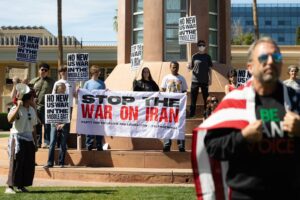
A new national survey conducted in March 2026 finds that a majority of Americans disapprove of the U.S. military campaign against Iran, signaling a difficult political environment for the conflict as it continues. The findings show that there is consistent skepticism not only toward the decision to use force, but also toward how the war is being handled and its potential long-term consequences.
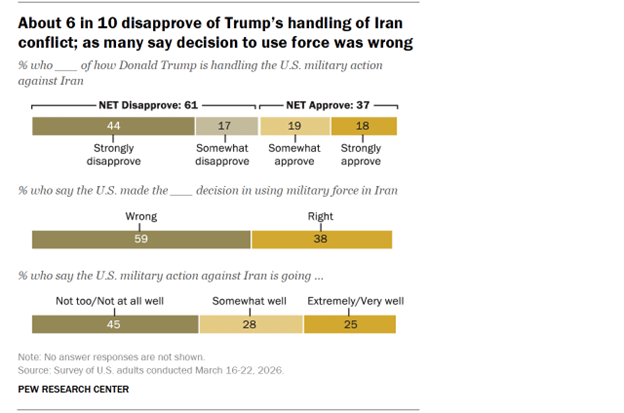
One of the most significant takeaways from the survey is the level of disapproval toward President Donald Trump’s handling of the conflict. About 61% of Americans disapprove, compared to a mere 37% who approve, demonstrating a clear gap in public sentiment. Closely tied to this is public opinion on the initial decision to use military force. The data shows a similar split, with 59% of Americans saying the decision to strike Iran was wrong, while only 38% say it was the right decision. This suggests that opposition is not simply limited to how the conflict is being managed but also includes the absence of legitimate justification for entering the war in the first place. Public views on how the conflict is unfolding further reinforce this skepticism. By nearly a two to one margin, more Americans say the war is not going well than say it is going well. Specifically, 45% say the military action is not going well, compared to 25% who say it is going extremely or very well.
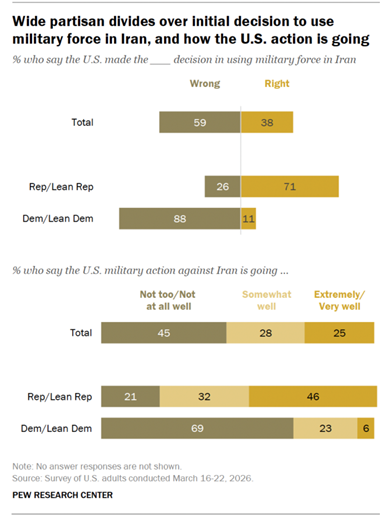
Among Democrats and Democratic-leaning independents, opposition is overwhelming. Nine in ten disapprove of Trump’s handling of the conflict, and 88% say the decision to strike Iran was wrong. These numbers reflect a near consensus within the Democratic Coalition. Republicans, by contrast, are more supportive, but not uniformly so. About 69% approve of Trump’s handling of the conflict, and 71% say the decision to use force was correct. However, this still leaves a notable share of Republicans who either disagree or remain uncertain. Divisions are even more visible among Republican-leaning independents, where opinion is nearly split, with 52% approving and 45% disapproving of Trump’s handling of the war.
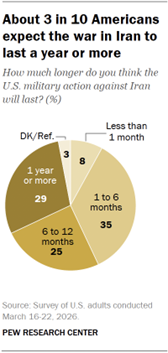
Another key area of concern involves expectations about the length of the conflict. A majority of Americans believe the war will continue for an extended period. About 54% say the military action will last at least six more months, including 29% who think it will last a year or more. Only a small share expects a quick resolution, with just 8% saying it will end in less than a month. These expectations vary by party. Most Republicans believe the conflict will end within six months, while a strong majority of Democrats expect it to last longer, including a significant share who believe it will extend beyond a year.
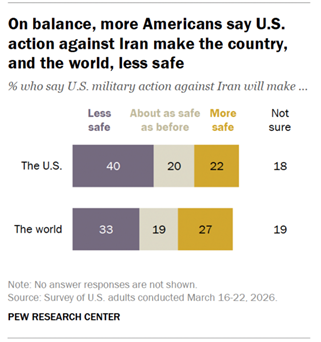
Lastly, Americans are far more likely to believe the conflict will make the United States less safe rather than more secure. About 40% say the war will make the U.S. less safe, compared to 22% who say it will make the country safer. Others believe it will make little difference or remain unsure. Views on global safety are more divided, but still lean negative, as 33% say that the war will make the world less safe, while 27% say it will make it safer – with the remainder split between no expected change and uncertainty.
From these findings, it is clear that a majority of Americans oppose the war, disapprove of how it is being handled, and express concern about its direction and consequences. The results suggest that the administration is operating without public support, a dynamic that could become increasingly significant as the conflict develops further.
Shifting Political Landscape in the U.S. Amid Economic Anxiety and Other Areas of Voter Dissatisfaction
Analysts and observers have highlighted an increasingly apparent shifting political landscape across the United States during the preceding months amid economic anxiety and other areas of voter dissatisfaction with the current administration. Between the major affordability and cost of living crisis, a flagging economy now exacerbated by the Iran war, high levels of public opposition to the aforementioned conflict, and outrage over the lack of transparency surrounding the release of the Epstein files, many who even previously supported the president are growing ever more discontent with Trump’s policies and actions. The evolving political landscape which has seen major electoral gains made for Democrats throughout the country reflects this trend. What is most noteworthy is that many of these shifts are not taking place in traditionally “blue” states or districts, but rather in “red” and “purple” ones. All of this indicates that while there is certainly a huge amount of anti-Trump sentiment among traditional Democrats themselves, much of what is actually driving the changing political climate is the rising dissatisfaction from non-Democrats.
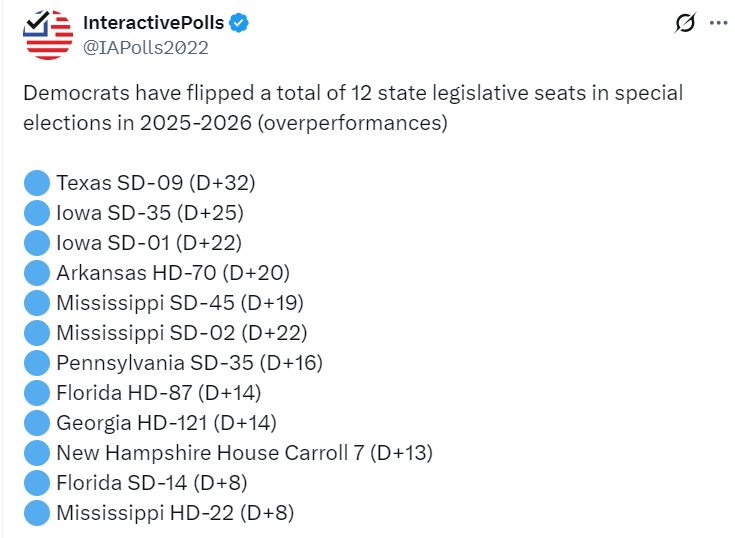
Evidence of this can be seen by the significant number of electoral seats that have flipped from Republicans to Democrats in recent months. In fact, Democrats have flipped a total of 12 state legislative seats from Republicans in special elections over the preceding months – with many of these taking place in so-called “red states.” In Texas, Democratic candidate Taylor Rehmet won in a deep-red district that has historically been held by Republicans. On top of the array of state legislative flips, Eileen Higgins became the first Democrat in nearly three decades to be elected mayor of Miami. It is not just the electoral wins themselves, but the margins of victory and the swings in favor of Democrats that have been so staggering and eye-opening. Among the 12 aforementioned state legislative special election flips, the swings towards Democrats ranged anywhere from 8 to 32 percentage points. This demonstrates the extent to which Republican candidates are losing voters to their Democratic counterparts, as the large percentage point swings show that many who normally vote for Republicans are now casting ballots for Democrats.
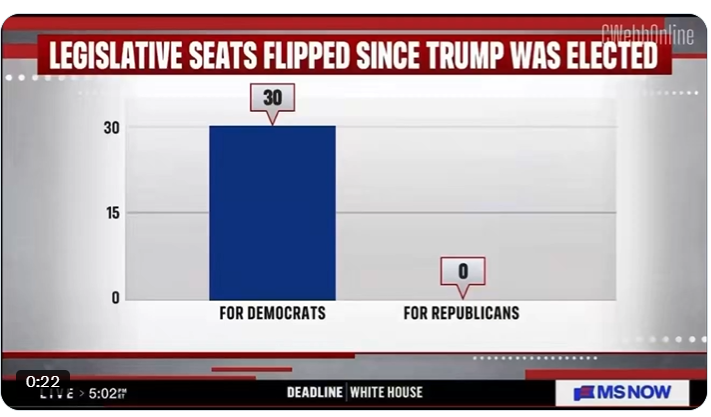
Democrats have flipped a total of 30 legislative seats since Trump was elected for his second term, compared to none for Republicans. Earlier this week, the electoral victory of Emily Gregory in Florida was seen as the latest indicator that Trump’s base is becoming more and more divided. Her win is especially noteworthy because her seat resides within a district that includes Trump’s home in Mar-a-Lago, and she prevailed over Jon Maples, who was endorsed by the president. On Monday, Trump urged voters to support Maples, as he was backed by “so many of his Palm Beach County friends.” To political analysts, the fact that Gregory flipped this seat, even though the other candidate was directly supported by the president, says a lot about how Trump is currently perceived in his own home county. It also could be a bellwether for the midterms later this year and signals that Democrats have a good chance to flip both houses of U.S. Congress. For now, a growing foothold in state government houses is important as it allows Democrats to have more say in setting local policies and pushing forward their political agenda ahead of November. Beyond mere party control, these electoral shifts also point to growing frustration among voters – particularly within the Republican Party. Local and state elections like these ahead of major federal ones later this year are normally a solid indicator of what way the public is swaying, so they suggest a larger trend of dissatisfaction that may very well manifest itself at the federal level in November.
One of the central reasons for this growing dissatisfaction is the ongoing war with Iran and the economic strains that it has exacerbated. In the time since the onset of the conflict, gas prices have risen substantially, and this is on top of already existing inflation and economic hardship for many Americans. The war has put pressure on global oil markets, which has impacted gas prices across the United States. Travel has also been increasingly stressful for the public because of long wait times, cancellations, and expensive ticket prices. Additionally, airport workers are not being paid because of the government shut down, prompting ICE agents to be deployed there despite lacking the qualifications needed to do the job. This has also raised concerns over proper training and public safety, contributing to public dissent.
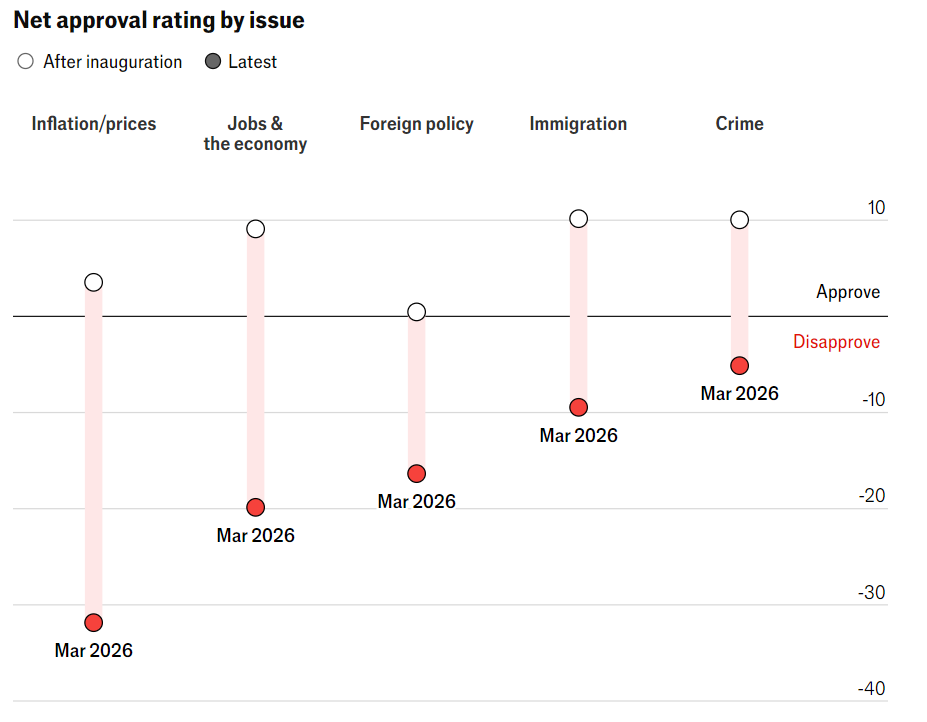
All of this is taking place as well amid a cost-of-living crisis and rising healthcare costs, which many people are frustrated with too. High interest rates and limited housing supply have made it increasingly difficult for many Americans to afford homes. This frustration can be reflected in the national net approval ratings by issue, which have seen Trump’s latest numbers dip across the board when it comes to inflation/prices, jobs and the economy, foreign policy, immigration, and even crime. The March 2026 ratings compared to those after Trump was inaugurated have included significant increases in disapproval, with jobs and the economy and inflation/prices in particular now consisting of disapproval-approval gaps of around 20 and around 30 percentage points, respectively. In total, approximately 58% of voters disapprove of Trump’s handling of the economy, as opposed to only 38% who approve. Similarly, the majority of Americans oppose U.S. military action against Iran. This has prompted more than 50% of voters to express that if the midterm elections were held today, they would prefer Democrats to control the House of Representatives – further reinforcing the idea that public opinion is shifting.
The major economic challenges, foreign policy concerns, and political shifts support the notion that Trump’s base is becoming more divided and that dissatisfaction with his policies is starting to grow at high levels, even among these voters. The significant number of flipped seats for Democrats in recent elections is ultimately a reflection of an undeniable shifting political landscape ahead of midterms later this year.

