
The National Interest Foundation Newsletter
Issue 321, February 13, 2026
Welcome to our NIF Newsletter. In this week’s edition, we delve into the growing concern over American Israel Public Affairs Committee (AIPAC) dark money influence ahead of the 2026 midterm elections, examine Israeli Prime Minister Netanyahu’s rush to Washington to ensure military action against Iran, discuss the Israeli Knesset’s passing of new laws to move close to annexing the West Bank in total violation of international law, and explore how the significant Epstein files release consequences abroad highlight the lack of similar domestic fallout thus far.
Editor: Bassam Tarbush
Growing Concern Over AIPAC Dark Money Influence Ahead of the 2026 Midterm Elections

With the 2026 U.S. midterm elections on the horizon, special interest groups like the American Israel Public Affairs Committee (AIPAC) have increasingly come under criticism for their attempts to influence elections. Voters across the country are seeing how these types of efforts without donor disclosure can shape races, often without the public knowing who is behind the spending. In recent months, we have seen this issue in New Jersey’s Democratic primary. A pro-Israel super PAC has spent hundreds of thousands of dollars backing one candidate and opposing another, even as local activists question whether outside spending should have this level of influence. The group’s spending is unusually high for a primary and has become a point of criticism from grassroots organizers, who argue that the scale of outside intervention risks overwhelming local voices and distorting what should be a community-driven contest.
This concern also echoes some events we saw in Illinois earlier this year. Reporting detailed how AIPAC took an unusual step of directly coordinating campaign operations in several legislative races, including volunteer recruitment, donor bundling, and messaging strategy. In multiple House primary contests, allied super PACs and affiliated groups poured substantial sums into down-ballot races that historically would not have drawn that level of outside attention. In some districts, millions of dollars were spent on television advertising and mailers supporting preferred candidates and opposing others, dramatically increasing the cost and intensity of what are typically lower-profile contests.
In Illinois, the scale and organization of the effort raised additional questions. Large networks of donors reportedly gave in coordinated patterns through super PAC structures, allowing significant financial backing to flow into targeted races while limiting public visibility into the original sources of funding. Funds were deployed early and aggressively, in some cases before full donor disclosures were due, meaning voters encountered heavy advertising without clear information about who was financing it. That level of involvement by a major lobbying group in state legislative races raised alarms among progressives who see it as another example of dark money or, at the very least, the exercise of shadowy political influence that voters cannot easily trace.
The Illinois effort was not isolated. During the 2024 federal election cycle, pro-Israel political action committees and affiliated organizations collectively spent well over 100 million dollars nationwide, combining direct campaign contributions with independent expenditures. Much of that spending was concentrated in Democratic primaries, where outside advertising campaigns sought to influence the outcome of competitive House races. The scale of these expenditures made the network one of the largest outside spenders in the country during the cycle. Critics understandably contend that the magnitude of the financial intervention gives a small set of well-funded interests disproportionate sway over candidate viability and messaging.
This opaque funding can come through super PACs, nonprofits under section 501(c)(4) of the tax code, and other organizations that spend on political messaging without revealing the sources of their funds. Dark money surged after the Supreme Court’s 2010 decision in Citizens United v. FEC, which allowed unlimited independent expenditures in elections. Spending by groups that hide their donors reached record levels in recent federal races, with close to $2 billion reported in the 2024 cycle alone. Analysts note that this figure does not fully capture all politically active nonprofit spending, meaning the true scope of undisclosed influence may be even greater.
For many voters, the result is familiar: politicians spend more time courting wealthy donors and special interest groups than negotiating with everyday constituents, and hence this is problematic. When outside organizations can inject millions of dollars into a primary, candidates are forced to respond to advertising blitzes and fundraising pressures that may have little to do with local priorities. Even when the spending is technically legal, the perception that powerful interests can effectively choose viable candidates before voters weigh in contributes to public frustration.
Politicians from both parties regularly call for fixing this problem, but there has been little progress at the federal level. Legislative proposals to strengthen disclosure requirements or limit certain forms of outside spending have stalled in Congress. At the same time, public dissatisfaction with how money influences elections has continued to grow. A national poll by Issue One and YouGov found that nearly 8 in 10 Americans agree that large independent expenditures by wealthy donors and corporations give rise to corruption or the appearance of corruption. This view spans all party lines, with 84 percent of Democrats, 74 percent of Republicans, and 79 percent of independents agreeing. A similar share says that the appearance of wealthy donors gaining influence over elected officials causes them to lose faith in democracy. Voters were also polled on a hypothetical ballot measure to eliminate dark money spending; about 72 percent said they would support such a reform if it had a chance on the ballot.
As debates over influence in New Jersey and Illinois continue, these numbers suggest that frustration with opaque political spending is not confined to one party or ideology. Whether the issue involves pro-Israel advocacy groups, corporate interests, labor organizations, or any other well-funded entity, the broader concern remains the same: when voters cannot easily trace who is paying for the messages shaping their elections, confidence in democratic institutions erodes.
Netanyahu Rushes to Washington to Ensure Military Action Against Iran
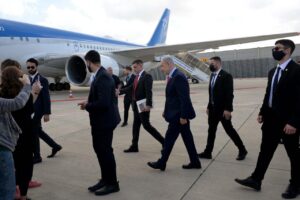
Israeli Prime Minister Benjamin Netanyahu was in Washington D.C. to meet with U.S. President Donald Trump yet again this week, marking his 7th visit in the past 12 months since Trump returned to the White House. Analysts were quick to highlight how the trip represented a clear attempt by Netanyahu to continue efforts to pressure Trump to adopt a harmful maximalist approach towards Iran – one that would sabotage the chances of diplomatic engagement with Tehran and instead likely result in dangerous military escalations. In fact, observers contend that the accelerated date for the Netanyahu-Trump meeting – which was originally due to take place next week – was pushed for by Netanyahu himself in response to the recent attempts at diplomatic progress via the U.S.-Iran negotiations last Friday in Oman. Rather than support the talks aimed at achieving a peaceful diplomatic solution to Iran’s nuclear program, it has become obvious to many that the Israeli efforts to push the American president to take a hardline approach that goes beyond merely Iran’s nuclear capabilities to also include the state of its ballistic missile program is designed to undermine the prospects of diplomacy. This is why those seeking to avoid the outbreak of a potentially protracted and destructive new conflict are urging U.S. officials to focus on considerations related to Iran’s nuclear program that are achievable through diplomatic engagement as opposed to adopting Israel’s maximalist approach which is viewed as a nonstarter.
For many, the main concern surrounding Israeli officials’ repeated attempts to sway the United States’ approach to Iran is that it risks dragging the U.S. into another harmful conflict in the Middle East. As such, impartial experts have argued that the United States should engage in tangible diplomatic efforts with Iran and not allow Israel to – as some have called it – “play spoiler” when it comes to the prospects of peaceful solutions. The attempts to impede diplomacy are troubling and jeopardize entangling the United States in endless “forever wars,” – something that Trump campaigned and vowed not to do. The separate non-nuclear related issues such as Iran’s ballistic missile program are blatantly being used by those who desire a direct conflict with Tehran to provoke this into taking place. Analysts have argued that in light of the recent negotiations in Oman, Netanyahu and other Israeli officials suspect that the U.S. may be less inclined to use military force against Iran – hence the clear-cut motivations behind the pushed-up meeting between Netanyahu and Trump. Moving this up serves as an effort to influence the U.S. approach to Iran before negotiations can progress any further. These talks are particularly important at a sensitive time like now when there is real concern over the possibility of a direct U.S. or Israeli attack against Iran.
While Trump has mobilized forces across the Middle East, the direction that the United States is headed remains uncertain. The recent talks in Oman highlighted how Iran continues to view non-nuclear issues like its ballistic missile program as a diplomatic nonstarter and a matter of national sovereignty. Therefore, the prospect of potential future talks will likely hinge on whether Trump prioritizes nuclear-related issues that can be achieved through diplomacy or adopts Israel’s maximalist and hardline approach that risks the outbreak of armed conflict. A direct U.S. attack on Iran or participation in Israeli attacks against Tehran would be counterproductive to the United States’ best interests. There are a multitude of destabilizing and harmful risks associated with launching or supporting an attack which could prompt a destructive widescale war in the Middle East – endangering American troops, resulting in the massive loss of life, damaging infrastructure, and entangling the U.S. in a protracted conflict. In the past, in places like Iraq and Syria, there is ample evidence of the U.S. being dragged into conflicts at the behest of others which ultimately proved to be not only unwarranted, but also counterproductive to the prospects of long-term peace and stability. Now, there is the same risk of this manifesting again regarding Iran and observers can only hope that the United States does not succumb to the pressures of warmongering forces. Despite the challenges, diplomacy with Iran remains the best path forward for the United States.
The uptick in international criticism of Israel’s actions and policies in recent years should prompt serious hesitation on the part of the United States regarding the damaging prospects of continued alignment with its foreign policy approaches. Observers have grown increasingly critical of the destabilizing role that the Israeli government has played throughout the Middle East and elsewhere, with concern that it is now hell-bent on provoking conflict with Iran. The United States should make policy decisions that prioritize its own best interests, especially given that alignment with Israel in the past has so often had harmful consequences.
Israeli Knesset Passes New Laws to Move Close to Annexing the West Bank in Total Violation of International Law

Israel’s latest plans regarding the occupied West Bank have caused sharp condemnation from governments, international institutions, and human rights organizations across the globe. At the center of the controversy are proposals to expand illegal settlements, formalize outposts, and in some cases move toward what is deemed de-facto annexation of territory that is universally recognized under international law as occupied land. For many observers, these steps threaten to permanently undermine the possibility of a two-state solution and further entrench illegal occupation. The West Bank has been under Israeli military occupation since 1967. The international community, including the United Nations, considers Israeli settlements in the territory to be illegal under the Fourth Geneva Convention, which prohibits an occupying power from transferring parts of its civilian population into the territory it occupies. As such, nearly the entire global community has consistently denounced Israel’s illegal settlement expansion efforts.
In recent months, Israeli officials have advanced plans that would significantly expand settlement activity and increase Israeli administrative control over large portions of the West Bank. Some of these proposals would legalize previously unauthorized outposts and accelerate construction in existing settlements. These steps come amid heightened tensions following the destructive war in Gaza and an alarming uptick in Israeli human rights violations and settler violence in the West Bank. The United Nations Secretary General has warned that moves to alter the status of the occupied territory violate international law and risk further inflaming the conflict. The European Union has reiterated its position that settlements are illegal and has cautioned that annexation would have serious consequences for Israel’s relations with Europe. Several European governments have summoned Israeli ambassadors to express formal protests.
A broad coalition of Arab and Muslim-majority nations have also voiced grave concern at the recent measures. Officials in Jordan and Egypt, both of which have peace treaties with Israel, have warned that annexation or large-scale settlement expansion could jeopardize regional stability. The Arab League has issued statements condemning the plans and calling for renewed international pressure to halt them. Recent reporting indicates that U.S. President Donald Trump has again publicly voiced opposition to formal Israeli annexation of the occupied West Bank as well. According to statements from the White House covered by outlets including Al Jazeera and The Guardian, administration officials said Trump does not back annexation and views unilateral moves to absorb West Bank territory as potentially destabilizing. The administration signaled concern that such steps could inflame tensions, complicate U.S. regional interests, and undermine efforts to contain violence.
Most countries view the West Bank as occupied territory and see settlement construction as a violation of international law. For decades, the two-state solution has been the cornerstone of international efforts to resolve the Israeli-Palestinian conflict. Moves that fragment Palestinian territory or entrench Israeli control are therefore seen as harmful to the prospects of peace and stability. Many analysts argue that unilateral steps risk sparking further unrest in the West Bank and beyond. Israeli settler violence has already reached unprecedented levels in recent years and expanding illegal settlements would be certain to exacerbate this even further. Ultimately, the scale and intensity of international criticism demonstrate the extent to which the global community understands that the plans are destructive to the prospects of long-term peace and social justice. With moves like these, Israel continues to expand its diplomatic isolation through its array of growing human rights violations – which highlight a blatant disregard for norms and principles of international law.
Significant Epstein Files Release Consequences Abroad Highlight the Lack of Similar Domestic Fallout Thus Far

The recent release of over 3 million pages of documents related to the Epstein files has seen a sharp divide in ramifications abroad compared to domestically here in the United States. At the international level, the network of political elites tied to the release have been facing intense scrutiny and public controversy, causing political fallout and resignations across Europe and elsewhere. In the United Kingdom, Peter Mandelson – former ambassador to the United States – resigned from the Labour Party and now faces a criminal investigation for relaying sensitive government information to the deceased convicted sex offender. This has triggered a major leadership crisis for the current U.K. government under Prime Minister Keir Starmer. In Slovakia, Miroslav Lajčák – a national security advisor to the Prime Minister Robert Fico – also resigned from his position in the aftermath of the Epstein files release. There were also significant consequences in Norway affecting an array of public officials including ambassadors, a former prime minister, and the country’s crown princess. Even this week, both Canada and the United Kingdom suspended ties to United Arab Emirates (UAE) firm DP World due to its CEO’s ties to Epstein. All told, outside of the United States, the release of the latest batch of files has resulted in immense pressure that has significantly harmed the credibility of individuals tied to them, making it difficult to maintain positions of power and a trustworthy public image.
Here in the United States, however, powerful figures whose names have been frequently found in the Epstein files have all but escaped any similar consequences thus far. This may be partially due to the fact that there is no concrete evidence tying specific figures to actual criminal acts, but despite this, ample documentation does shed light on extensive ties between notable public figures and Epstein – lending itself to understandable questions as to their potential awareness and involvement. At the very least, many observers have argued that there should be serious investigations into those who were found to have a long history of ties to Epstein, especially given the years of knowledge of his criminal activities and the massive scale of them as well. Of course, prosecutors must have evidence of specific illegal acts in order to build a case. Furthermore, statements alone are not enough for criminal prosecution; there must be witnesses willing to testify and time makes prosecution harder because evidence fades. For instance, records can be lost, physical evidence can disappear, and the statute of limitations may expire, but perhaps one of the most difficult things prosecutors are dealing with – besides searching for substantial proof that individuals in the files knew minors were involved, participated in the trafficking, and knowingly conspired – is navigating how the Department of Justice inadequately redacted the files.
In a recent highly contentious Congressional hearing with U.S. Attorney General Pam Bondi, various lawmakers pointed out their legitimate concerns over how several of the victims’ personal information was left open to the public, while at the same time, the names of co-conspirators and information about U.S. President Trump himself were blacked out. This raises understandable questions about what the public is being allowed to see and who, if anyone, is being protected. There are still documents linked to the Epstein files that have yet to be released – something that Congressmembers highlight goes against the Epstein Files Transparency Act, which was signed into law by President Trump late last year and stipulates that all files must be released. Furthermore, on top of the fact that documents are still being withheld, U.S. lawmakers have accused the Justice Department of inappropriately redacting various names in the files, with whole pages blacked out for reasons unbeknownst to the public. Democratic U.S. Representative Ro Khanna and Republican U.S. Representative Thomas Massie viewed versions of the files that were not publicly released. After reading through some of these, Khanna saw fit to read aloud a set of six names he found in the documents including Sultan Ahmed bin Sulayem, Nicola Caputo, Leonic Leonov, Leslie Wexner, Zurab Mikeladze, and Salvatore Nuara. These names were previously concealed by the Justice Department and are not names of victims, so Khanna inquired as to why they were hidden. Khanna, Massie, and others have criticized the Justice Department for their lack of transparency in justifying their actions, which they contend amounts to a mishandling of the documents, and have therefore urged them to comply with the Epstein Files Transparency Act going forward.
Critics who have questioned the lack of fallout and the manner in which the process of the files release has played out also point out that throughout it, President Trump has attempted to redirect attention away from himself and the files entirely. For example, he has threatened lawsuits against outlets like the Wall Street Journal, which have been unsuccessful because their reporting is considered independent. Trump has also posted statements on social media and the White House Official Government Webpage that attempt to frame the files as a political issue. On Truth Social back in July, he wrote that the files were a “Democrat Epstein Hoax” meant to “deflect and distract from the greater success of a Republican President.” This is despite the fact that during his 2024 campaign, one of his major promises was that the Epstein files should and must be released immediately, yet now over a full year into his second term, we still only have limited access with valid questions as to why this is the case and what the administration may be attempting to conceal. Adding to the unease is how countries across Europe, and even Canada, have implemented various reactive measures and acted swiftly against those mentioned in the Epstein files, compared to the lack of similar domestic fallout in the United States.
In many countries, the release of the Epstein files has caused societal outrage, leading to the resignation of key figures. These consequences are largely due to social pressure rather than mere government intervention, proving that society can influence action, even without legal ramifications. By contrast, the United States has not had many visible repercussions against people in the Epstein files. Experts note that under Trump’s current presidency, U.S. relationships with other countries have been strained – as exemplified in the withdrawal from UN agencies, sanctions against the UN, and other similar decisions. Thus, even with widespread international scrutiny over the Epstein files, the Trump administration has largely ignored external pressure. This combined with domestic legal policies, complicated influential networks, and questions surrounding the transparency of the release process has left many American figures free from significant consequences thus far.

