
The National Interest Foundation Newsletter
Issue 333, May 8, 2026
Welcome to our NIF Newsletter. In this week’s edition, we delve into the unprecedented levels of Israeli settler violence in the West Bank and the harmful absence of U.S. and international action, examine Iran and the U.S. weighing a potential deal to bring an end to the war, and provide analysis on a recent Pew survey which found that more Americans believe the United States’ global influence is getting weaker rather than stronger.
Unprecedented Levels of Israeli Settler Violence in the West Bank and the Harmful Absence of U.S. and International Action

The scale of Israeli settler violence in the occupied West Bank has reached a critical and unprecedented level in recent years. Last year, in 2025, saw the highest number of attacks on record, and 2026 is on track to exceed this yet again. Global humanitarian watchdog organizations have drawn attention to the alarming uptick since 2021 in particular – with 446 incidents being recorded that year compared to the whopping more than 1,800 documented in 2025. Since 2023, each year has seen a new record high of attacks as the annual number has rapidly increased from around 1,200 in 2023 to the aforementioned 1,800+ last year. During the first three months of 2026 alone, more than 1,600 attacks have been documented and as such the figure this year is certain to surpass 2025’s already unprecedented level. Equally as troubling as the continuously growing scale of settler violence is how these often occur with the complicity or direct participation of Israeli forces. The attacks are bolstered by an environment of impunity whereby documented incidents result in no criminal charges. Thus, rights groups have outlined the systematic manner in which these actions are enabled, supported, and even protected by Israeli state institutions – with the violence functioning as a means of seeking to forcibly displace and intimidate Palestinians in order to expand illegal settlements and territorial control. Exacerbating this highly concerning issue even further is the absence of U.S. and international punitive measures as well, which has fueled the massive uptick in violence and perpetrators’ sense of immunity from any form of accountability.
A primary driver of this escalating crisis is the increasingly blurred line between settler groups and the Israeli state apparatus. In recent years, thousands of illegal settlers have been integrated into military reserve units, leading to numerous documented cases where attacks on Palestinian civilians are carried out either with the active participation of the military or under its explicit protection. Furthermore, the institutionalization of unlawful land seizures has accelerated through administrative measures that streamline settlement expansion while imposing restrictive land registration procedures on Palestinians. This systematic cooperation, coupled with a pervasive climate of legal impunity where perpetrators rarely face investigation or prosecution, has fostered an environment that has allowed the scale of settler violence to grow at a never-before-seen rate.
The global community’s response to the concerning phenomenon has been marked by a profound gap between rhetorical condemnation and enforceable action. While the United Nations and the International Court of Justice have repeatedly reaffirmed that the occupation and settlement activity are unlawful under international law, these declarations have not translated into a coordinated global enforcement mechanism. Many nations have issued statements expressing concern, yet the lack of concrete punitive measures has allowed the situation on the ground to deteriorate without significant consequences. This fragmentation has emboldened those taking part in and enabling the violence, signaling that the international legal order is unable or unwilling to impose meaningful consequences for the grave violations being committed.
Central to the absence of action is the United States’ failure to hold Israel accountable for illegal settler violence, especially as it has escalated to unprecedented levels in recent years. While the Biden administration took the step of issuing sanctions against individual violent settlers and entities in early 2024, many observers argued that these measures were largely symbolic and “bandaged” a systemic problem without addressing the underlying Israeli state support for settlement expansion and settler violence as well as its legal, military, and financial cover for these actions. These efforts were then further undermined when the Trump administration rescinded all settler-related sanctions on its first day in office in 2025, which some analysts described as essentially “green-lighting” settler violence. Despite a major uptick in attacks – including at least nine Americans killed in the West Bank since 2022 without any perpetrators being held responsible – the U.S. has often declined to join UN Security Council condemnations of illegal settlement activity, instead opting to relay high levels of concern but failing to impose meaningful material consequences. For these reasons, U.S. inaction has been criticized for decades – a dynamic that many contend has directly contributed to the worsening of the problem.
Ultimately, the escalating Israeli settler violence in the West Bank serves as a sobering indictment of the current international order’s inability to uphold its own legal standards. The mere fact that systematic state-enabled and sponsored violence has gone unpunished is a stark reminder of the pervasive culture of impunity that continues to undermine the rule of law and the prospects for peace. As long as the international community limits its response to verbal rebukes without imposing tangible consequences, it risks allowing for the circumstances whereby violence, intimidation, and forced displacement is wrongfully tolerated. When powerful states and global institutions fail to move beyond symbolic denunciation and towards actual concrete forms of accountability, they undermine their own moral standing and the principle of universal human rights.
Iran and the U.S. Weigh a Potential Deal to Bring an End to the War

What is likely to unfold next on the Iran front largely hinges on the prospect of a one-page memorandum of understanding, which is being deliberated this week between the United States and Iran. Among various provisions, the deal would involve Iran committing to a moratorium on nuclear enrichment, the United States agreeing to lift its sanctions and release billions in frozen Iranian funds, and both sides lifting restrictions around transit through the vital Strait of Hormuz. The memo is designed to declare an immediate end to the conflict, while also initiating a 30-day period to negotiate a final and more detailed agreement aimed at resolving key existing issues. Analysts describe the memo as the closest that the two sides have come to ending the conflict, though experts warn that significant sticking points remain regarding areas such as the disposal of Iran’s enriched uranium stockpile and ramped up pressure from U.S. threats to resume military action if negotiations fail. All of this has prompted many observers to contend that the situation remains extremely fluid, with a high risk of escalation if negotiations break down – either before or during the potential 30-day period.
At the heart of the memorandum would be a mutual commitment to economic and maritime stability. A primary driver for the agreement is the reopening of the Strait of Hormuz, where the lifting of blockades would allow the resumption of global oil transit. In exchange for this vital concession, the United States is reportedly prepared to offer significant sanctions relief and the release of billions of dollars in frozen Iranian assets. This exchange addresses the immediate existential pressures on both sides: the global need for energy security and Iran’s urgent requirement for economic stabilization. Under the deal, Iran would agree to a moratorium on uranium enrichment – believed to be a period of at least 12 years but potentially up to 15. During previous failed negotiations, Iran proposed a 5-year moratorium while the U.S. demanded 20. According to analysts and experts however, the brevity of the document carries inherent risks, as the lack of detailed verification protocols for assessing this could lead to future disputes during the implementation phase.
Beyond the importance of the attempts to stave off a resumption of the conflict, the circumstances surrounding it have become a central pillar of global economic security. The continued disruptions and contested status of the Strait of Hormuz have kept global oil and gas prices at record highs, threatening a worldwide recession. Consequently, the role of external powers like China and Russia has become more pronounced. Iran is increasingly looking toward Beijing for a “strategic partnership” to bypass Western sanctions, while the U.S. faces pressure from allies to stabilize the energy market. Thus, preventing a resumption of the war is essential for global economic security, as the conflict has already triggered the largest supply disruption in the history of the global oil market. In addition to oil and fuel, the war has disrupted supply chains for vital industrial inputs like helium and aluminum, threatening the automotive, aerospace, and semiconductor industries. This has prompted global organizations like The International Monetary Fund (IMF) to warn that a return to full-scale war could tip the world into a recession – leading to trillions in lost output, skyrocketing food prices due to fertilizer shortages, and millions of job losses across the Middle East and elsewhere.
Due to all of this, what transpires next on the Iran front is critical. While both sides appear wary of a resumption of direct hostilities and potential protracted conflict, the margin for error is extremely thin. If the current memorandum of understanding fails to materialize or even faces major obstacles during the proposed 30-day period for more detailed negotiations and agreement, there is a strong likelihood of renewed hostilities and a further deepening of an already severe global economic and maritime crisis.
Pew Survey Finds That More Americans Believe the United States’ Global Influence is Getting Weaker Rather Than Stronger
A recent Pew Research Center survey highlighted how a significant plurality of Americans (by a margin of 41% to 34%) think that the United States’ influence around the world is weakening as opposed to strengthening. To many observers, this perception indicates a growing belief that the country’s international standing has declined in recent years. By a notable margin, Americans deem a palpable drop in global influence, with this being cited more frequently as a top-of-mind concern as compared to years past. The data suggests an increasingly widespread contention among U.S. public opinion that the country’s global role is not as strong as it was previously.
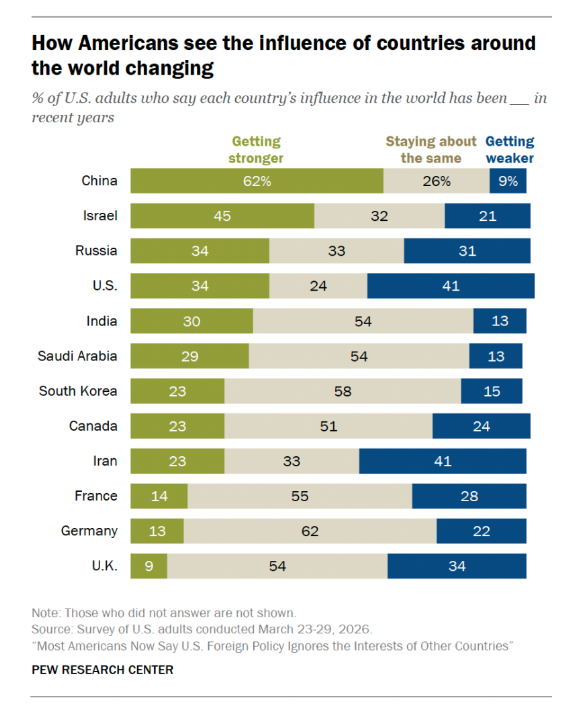
In addition to the sentiment among Americans that the United States’ influence in the world has been getting weaker in recent years as opposed to getting stronger by a 41% to 34% margin, the Pew survey also shed light on other interesting findings. When it comes to China, a substantial majority of all respondents (62%) – not just a plurality – expressed the view that the country’s global influence has been getting stronger in recent years, while less than 1 in 10 (9%) said that it was getting weaker. Furthermore, a growing share contend that Israel’s global influence is strengthening – with the 45% figure up 7 percentage points from last year. However, at the same time, Americans’ overall opinion of Israel is getting increasingly more negative, as another recent Pew survey found that 60% of U.S. adults have an unfavorable view of Israel which is up from 53% last year. It was also noteworthy to see that traditional European powers like the United Kingdom, France, and Germany were all perceived as getting weaker as opposed to getting stronger by significant margins: 14 percentage points in the case of France, 9 percentage points in the case of Germany, and a particularly sizable 25 percentage points in the case of the United Kingdom. All of this would suggest that many view other non-European countries as gaining notable levels of global influence at their expense.
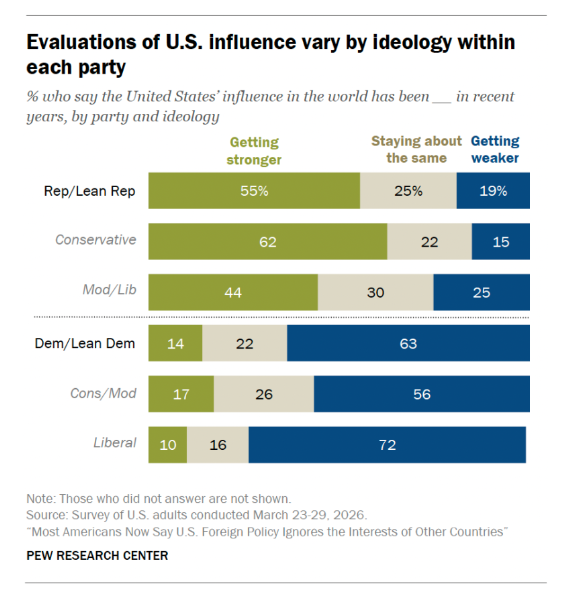
While the aforementioned plurality of Americans overall believe that the United States’ global influence has been waning in recent years, the perceptions regarding this vary considerably by political party affiliation and even among ideological wings of Republicans and Democrats. In general, Republicans are more likely than Democrats to actually say that the United States’ global influence is getting stronger – and it is conservative Republicans in particular who largely believe this. In total, 62% of conservative Republicans deem that American global influence is getting stronger in recent years compared to 44% when it comes to their more moderate or liberal Republican counterparts. On the other hand, Democrats overwhelmingly believe that the United States’ influence in the world has been getting weaker in recent years, but this is especially pronounced among liberal Democrats – with 72% believing this compared to a small majority (56%) of more moderate or conservative Democrats. The findings demonstrate a consistent pattern among the entire political spectrum whereby perception regarding U.S. global influence is in line with how far ideologically “left” or “right” one sits.
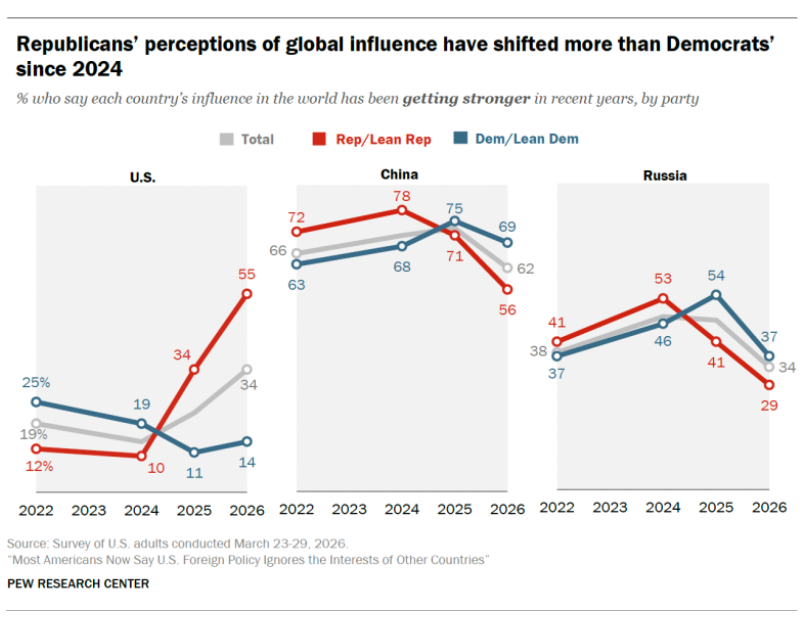
There has also been a much larger shift among Republicans than Democrats when it comes to their perceptions of the United States’ global influence. Since 2024, the change in this figure for Democrats has only shifted by 5 percentage points (down from 19 to 14) compared to a gigantic 45 percentage points (up from 10 to 55) among Republicans. The difference is stark, although probably not totally surprising given that many Republicans’ views have likely changed so drastically during the past two years for largely partisan reasons since Former Democratic President Biden left office and Republican President Trump began his second term. The fact that the percentage of Republicans who felt the United States’ influence in the world jumped so significantly from around 10% during the years of Biden’s presidency to 34% and then 55% in Trump’s first two years back in office indicates that the political environment within the United States is a major determining factor in this vast uptick.
In the end, the overall shifting tide of U.S. public opinion regarding the United States’ global standing is telling. The Pew Research Center’s finding – that a 41% plurality of Americans now view their country’s global influence as waning – suggests that the era of unquestioned American primacy in international affairs is giving way to an evolving one in which other countries like China are gaining a significant foothold. Moving forward, this perception signals that one of the major challenges in the coming years will not only be about navigating various foreign policy considerations but also about reconciling the nation’s global role and reputation on the international stage.

