
The National Interest Foundation Newsletter
Issue 330, April 17, 2026
Welcome to our NIF Newsletter. In this week’s edition, we provide analysis regarding the electoral defeat of Viktor Orbán in Hungary and its connections and implications for U.S. President Trump, examine the U.S. imposing a naval blockade in the Strait of Hormuz following failed negotiations with Iran, discuss the United States’ worsening relations with major European allies as a result of widespread opposition to the Iran war, and look into Trump’s feud with Pope Leo XIV and its risks of alienating a key voting bloc of conservative Catholics.
The Electoral Defeat of Orbán in Hungary and Its Connections and Implications for Trump
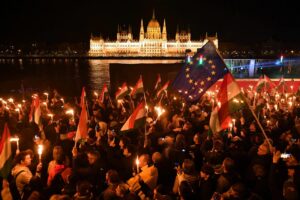
The electoral defeat of Viktor Orbán marks a significant turning point not only for Hungary, but also for the large network of political alliances that have linked European populist leaders with figures in the United States. For years, Orbán positioned himself as a leader in a conservative movement aligned with U.S. President Trump. His loss, now, raises questions about the durability of that alignment and its political consequences. One of the most notable aspects of the election outcome is the role that association with Trump may have played in weakening Orbán’s standing. While Orbán built his appeal to voters on nationalism and opposition to liberal European institutions, his visible ties to Trump and the Make America Great Again (MAGA) movement appear to have become a liability among segments of the Hungarian electorate. Anti-Trump sentiment, which has intensified internationally and particularly across Europe in recent years, translated into backlash against leaders seen as closely aligned with him. The election served not only as a referendum on Orbán’s governance, but also as an indirect test of the current state of Trump-style politics abroad.
U.S. Vice President JD Vance held a high-profile rally in support of Orbán days before the election, framing it as part of a larger ideological struggle. Other Trump-aligned figures and media outlets also voiced strong support, emphasizing shared priorities on immigration, national identity, and opposition to liberal institutions. These efforts, however, appear to have had negative results. Rather than consolidating support, they may have heightened concerns among Hungarian voters about external influence and political alignment with a polarizing foreign leader.
Trump and his allies have consistently criticized any form of purported foreign involvement in domestic elections, particularly within the United States. Yet their open support for Orbán, including campaign appearances and public endorsements, reflects a willingness to engage in similar behavior abroad. Critics have pointed to this as an example of political inconsistency, arguing that opposition to election interference is applied selectively rather than as a universal principle. The visibility of this contradiction may have further complicated Orbán’s position, reinforcing concerns that his government was too closely tied to external actors.
For Trump, this electoral loss of a close ally serves as a major setback in his effort to position these types of leaders around the world as evidence of a growing ideological movement. Orbán had often been cited as a successful example of nationalist governance within Europe, and his removal from power disrupts that narrative. It also raises questions about whether similar political models can sustain long-term support, particularly when linked to controversial international figures. Trump’s brand has long relied in part on the perception of momentum, both domestically and internationally. The defeat of a prominent ally could weaken that perception, especially if it is interpreted as evidence that voters are turning away from this style of leadership. While there is no current direct electoral impact within the United States, for now, the symbolic significance is hard to dismiss.
Hungary under Orbán often positioned itself at odds with the European Union (EU), particularly on issues related to democratic standards and the rule of law. A new government could seek to repair these relationships, potentially altering Hungary’s role within the bloc. This would have implications for EU cohesion, especially at a time when unity is seen as critical in addressing geopolitical challenges. Relations with Russia and Ukraine are also likely to be affected. Orbán maintained a more conciliatory stance toward Russia than many of his European counterparts, often resisting efforts to impose stricter measures. A change in leadership could bring Hungary more in line with broader European policy, particularly in the context of ongoing tensions involving Ukraine. Such a shift would contribute to a more unified European approach, though it may also introduce new domestic political debates within Hungary. Orbán’s government also cultivated close ties with Israel, aligning with officials who emphasized strong bilateral relations and shared political outlooks. A new administration in Budapest may maintain aspects of this relationship but it could also recalibrate its approach depending on broader foreign policy priorities and domestic pressures.
Domestically, Orbán’s defeat ended a long period of political dominance that reshaped Hungary’s institutions and political culture. The incoming leadership faces the challenge of navigating a deeply polarized environment while addressing concerns about governance, economic conditions, and international alignment. The transition may also serve as a test of how resilient Hungary’s democratic institutions are after years of centralized power.
For Europe, the election result may indicate that populist movements now face limits that they had not struggled with as much in the past. While such movements have the potential to remain influential, their ability to maintain support over time may depend on adapting to changing public sentiment rather than relying on established alliances. In the end, Orbán’s defeat marks a new and significant shift with implications that might extend beyond Hungary, particularly for Trump and his allies.
U.S. Imposes Naval Blockade in the Strait of Hormuz Following Failed Negotiations with Iran

This past weekend, following the initiation of a two-week ceasefire, negotiations between the United States and Iran took place in Pakistan with the aim of bringing a permanent end to the conflict. However, after 21 hours of deliberation, both sides failed to reach an agreement due to disagreements regarding several core issues. These consist of uranium enrichment, the inclusion of Lebanon as a part of the ceasefire deal, the lifting of sanctions and release of frozen assets, control and fee collection in the Strait of Hormuz, the state of Iran’s missile program, the presence of American troops in the region, and repatriation for damage caused by U.S. and Israeli attacks on Iran. With respect to uranium enrichment, outlets reported that Iran offered to stop doing so for 5 years, but the U.S. insisted on 20 years. The United States flatly rejected Iran’s demand for U.S. troop withdrawal, only offered partial relief to Tehran’s seeking of the lifting of sanctions and releasing of frozen assets, and changed its position regarding a ceasefire in Lebanon as a part of the initial agreement at the request of Israeli Prime Minister Netanyahu. U.S. negotiators also failed to respond to Iran’s request for repatriation while refusing Iran’s desire to control and charge a fee for the Strait of Hormuz – with Trump instead at some point offering joint control and sharing of the fee with Iran. On the other side, Iran refused any restrictions on its missile program. All of this has led many analysts to outline that the Trump administration’s adoption of a maximalist approach towards Iran has resulted in a set of circumstances which seem unlikely to produce a long-term deal unless a pivot is made to more realistic and incremental concessions that can resolve the stalemate.
After the failed negotiations, U.S. President Trump relayed his intent to impose a naval blockade in the Strait of Hormuz directed at vessels entering or leaving Iranian ports and coastal areas. The blockade has been characterized by legal observers as a potential violation of international law and one that risks garnering a response from Iran, and in turn, escalating the conflict. Experts note that while blockades can be legitimate acts of war, their legality is generally tied to an active state of war. Thus, this occurring during the midst of the two-week ceasefire has been labeled as highly questionable and problematic. It is therefore unsurprising that the global community’s response to the blockade has been mostly negative amid rising concern over the risk it poses to prompting further escalations and hindering the prospect of long-term stability. U.K. Prime Minister Starmer remarked that the action is “deeply damaging” and relayed the United Kingdom and France’s intent to co-host a summit aimed at working out a plan to safeguard international shipping and restore freedom of navigation in the Strait of Hormuz. More than 40 other countries are expected to attend the summit, highlighting the global community’s widespread concern over the continued disruptions that are being caused by the Iran war.
As officials from the United Kingdom, France, and others have distanced themselves from the Trump maneuver and voiced deep concern over it, notable global powers like China have done the same. Beijing has officially condemned the blockade as “dangerous and irresponsible,” lamenting that it threatens international trade and exacerbates already troubling tensions. As a primary buyer of Iranian oil, China of course also fears what prolonged hostilities and persistent disruptions would mean for it economically and has taken a de-escalation stance – urging for continuation of the ceasefire. Economics have warned that sustained high oil prices will accelerate inflation, particularly in food and consumer goods, due to increased transportation costs and disruptions to the supply of fertilizers and industrial materials like helium and naphtha. As the world’s largest energy importer, China is expected to be hit hardest by the “slow hemorrhage” of higher import costs and is therefore – predictably – particularly concerned with what the perpetuation of hostilities could mean.
Even at the larger-scale full global level, the disruptive economic implications of these new developments are expected to be severe as well, especially the longer that they drag on. Another blockaderemoves additional oil from the markets, driving prices even higher, and increasing the likelihood of further escalation. This has already prompted many experts to speculate that the impact of the disruptions to the Strait of Hormuz will be felt long after the war is over, negatively affecting both trade and energy markets. International organizations have also issued warnings, with the UN Food and Agriculture Organization cautioning that continued obstructions could trigger a global food catastrophe, while officials from the International Energy Agency have labeled the situation as “the greatest energy security challenge in history.” Thus, it is clear to many that the failure of recent U.S.-Iran negotiations and the subsequent decision to initiate an American naval blockade has highlighted how the Trump administration’s maximalist approach towards Iran is preventing meaningful progress from being achieved. If this continues, it is more likely than not that negotiations will remain fruitless and open the door for renewed hostilities.
The United States’ Worsening Relations with Major European Allies as a Result of Widespread Opposition to the Iran War
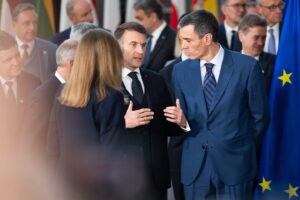
Relations between the United States and several of its closest European allies have entered a period of major strain, driven largely by disagreements over the Trump administration’s handling of the Iran conflict. Countries that have long been central to U.S. relations and foreign policy coordination, including the United Kingdom, France, Germany, Italy, and Spain, have expressed varying degrees of opposition to the Iran war and the U.S. administration’s actions within the context of it, creating a divide that has increasingly become harder to contain. European leaders have largely favored de-escalation, diplomatic engagement, and multilateral coordination, while the Trump administration has taken a more force-driven path. This divergence has been reflected in official statements, emergency meetings, and diplomatic exchanges, many of which have highlighted frustration with the lack of coordination between Washington and its traditional partners.
The response from European governments has not been uniform, but the overall direction has been consistent. Leaders in France and Germany have publicly called for restraint and renewed negotiations, emphasizing the risks of a prolonged conflict. The United Kingdom, while historically one of the United States’ closest allies, has also shown discomfort with the trajectory of the situation, balancing its security relationship with concerns about escalation. Other European countries such as Italy and Spain have echoed similar themes, focusing on the economic and security risks that instability in the Middle East poses for Europe and the world at-large.
European officials have raised questions about predictability, consultation, and commitment to shared frameworks. The perception that major decisions are being made without meaningful input from allies has contributed to a sense of uncertainty about the reliability of the United States as a partner. Joint initiatives have slowed, coordination on sanctions and security measures has become more complicated, and public messaging has grown less aligned. In some cases, European leaders have taken steps to distance themselves from U.S. actions, signaling to both domestic and international audiences that they do not support the current approach. This distancing, while measured, represents a notable shift in tone from previous periods of close alignment.
The Iran war has contributed to rising energy prices and market instability, issues that directly affect European economies. Governments are facing pressure from businesses and voters who are concerned about inflation, supply disruptions, and the potential for a wider economic downturn. These pressures make it more difficult for European leaders to support policies that are seen as contributing to instability. For decades, U.S. leadership has been associated with coalition building and the ability to bring allies together around common goals. The current tensions risk weakening that perception, particularly if allies continue to feel sidelined in key decisions. Reputational shifts of this kind can have lasting effects, influencing how other countries approach cooperation with the United States in the future.
While there is no immediate indication of a breakdown, differences over major security issues can create friction that affects planning, resource allocation, and long-term strategy. Diplomatic engagement between the United States and its European partners is ongoing, and there remains a shared interest in avoiding a complete rupture. At the same time, the longer the Iran conflict continues without a clear resolution, the more difficult it may become to recalibrate alignment. For now, the situation shows us a moment of friction and discord in a relationship that has long been considered stable and vital to the state of global affairs.
Trump’s Feud with Pope Leo XIV and Its Risks of Alienating a Key Voting Bloc of Conservative Catholics
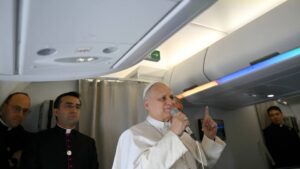
President Trump’s unprecedented attacks against Pope Leo XIV have created a significant cultural and political rift that is fueling deep unease and discomfort among many conservative Catholics. Pope Leo XIV – the first American-born pontiff – has been a vocal critic of the current administration’s military actions in Iran and has recently drawn the ire of Trump. The American president’s personal insults against the Pope and his use of blasphemous messianic imagery have garnered heavy criticism from Catholic advocacy groups. These have been seen by many as a sharp deviation from the high levels of respect typically afforded to the papacy by leaders from around the world. All of this has led analysts to speculate that the rift risks dampening Republican turnout among more traditionally conservative-leaning Catholics in the upcoming 2026 midterm elections.
The questionable nature of the Trump administration’s military actions and rhetoric in Iran has prompted Pope Leo XIV – like many others – to speak out against this. In turn, Trump’s attacks against the Pope and his posting this week of an AI-generated image depicting himself in a Christ-like form have sparked intense backlash. Prominent conservative allies have condemned these as blasphemous and outrageous, arguing that they cross a line by on the one hand attacking a highly revered religious figure and on the other equating the president with Jesus Christ. On top of the near across-the-board denunciation that they have garnered, observers also highlight the significant risks of political fallout as a result of them as well. Conservative and moderate Catholics were a key demographic in Trump’s electoral triumphs and form a considerable chunk of his political base. In fact, Trump won a significant majority of this demographic back in the 2024 presidential election, securing 55% of the Catholic vote.
Trump’s attacks against Pope Leo XIV are made potentially even more damaging considering that the latter is the first American-born pontiff. Given that he was born and raised on the South Side of Chicago, his legitimate critiques of the president’s actions carry weight and relatability among many Americans, let alone Catholics in particular. As the first American to lead the global Catholic Church, Pope Leo XIV is a source of immense national pride for the more than 50 million Catholics across the United States. Experts note that his background provides him with a unique credibility among much of the American electorate, with Trump’s attacks being viewed as especially egregious and forcing even some of the president’s most loyal conservative allies to publicly defend the Pope.
For his part, Pope Leo XIV has conveyed that he has no fear of the Trump administration and declared that the Catholic Church is meant to encourage peace – and therefore, he will continue to speak out against unnecessary war and aggression. The Pope has remained undeterred, insisting that his message of “disarmed peace” is rooted in the Gospel rather than politics. As the Trump administration continues to navigate the Iran war and the immense levels of criticism that it has brought about, the Pope’s response to Trump’s offensive and personal attacks signals a papacy that will continue to prioritize its role as a global moral authority. Ultimately, the back-and-forth between Trump and Pope Leo XIV has risked fracturing yet another notable segment of the population as a result of opposition to the Iran war. Many within the president’s base were already disenchanted with the highly criticized war efforts, and now, Trump’s feud with the Pope has exacerbated this even further. The attacks on the Pope are likely to alienate a demographic that has been integral to Trump’s past successes at a time when Republicans are already facing the threat of serious electoral losses in the lead up to the upcoming 2026 midterms.

